Group Dynamics (The Army versus The Poem)*
Two approaches to collective movement in spacetime
GEM Core
Within the GEM Method, Group Dynamics* explores how individual movements relate to one another and together form a collective movement pattern in spacetime*. It focuses on two approaches: collective uniformity (The Army) and individual Expression within a shared composition (The Poem).
The GEM Method provides terms for exploring the interplay between Form, Weight Actions*, Muscle Dynamics*, timing and perception. It focuses on the relationship between group cohesion and individual Somatic Autonomy*. How can a group function as a whole while each practitioner continues to perceive and regulate their own movement possibilities?
1. WHAT (The System)
In the GEM model, Group Dynamics* describes the interaction between individual movements and the collective patterns that dancers form in spacetime*, whether they move in formation or as part of a larger group. The concept helps you explore and categorise how practitioners coordinate and communicate through movement.
In the GEM Method, Group Dynamics* concerns how the sensory information and movements of different people relate to one another.
This part of the model focuses on the relationship between the group and the individual. External Perception* (exteroception*) provides information about the positions and movements of partners and other group members. This sensory information gives you a starting point for exploring how the group’s Context* relates to the way you use and coordinate the moving parts of your Physical Carrier*.
2. HOW (The Two Approaches)
The GEM Method explores group interaction and choreography through two approaches. Each has its own practical aim and its own way of using and regulating movement. Both can be applied in competitive sport and theatre arts.
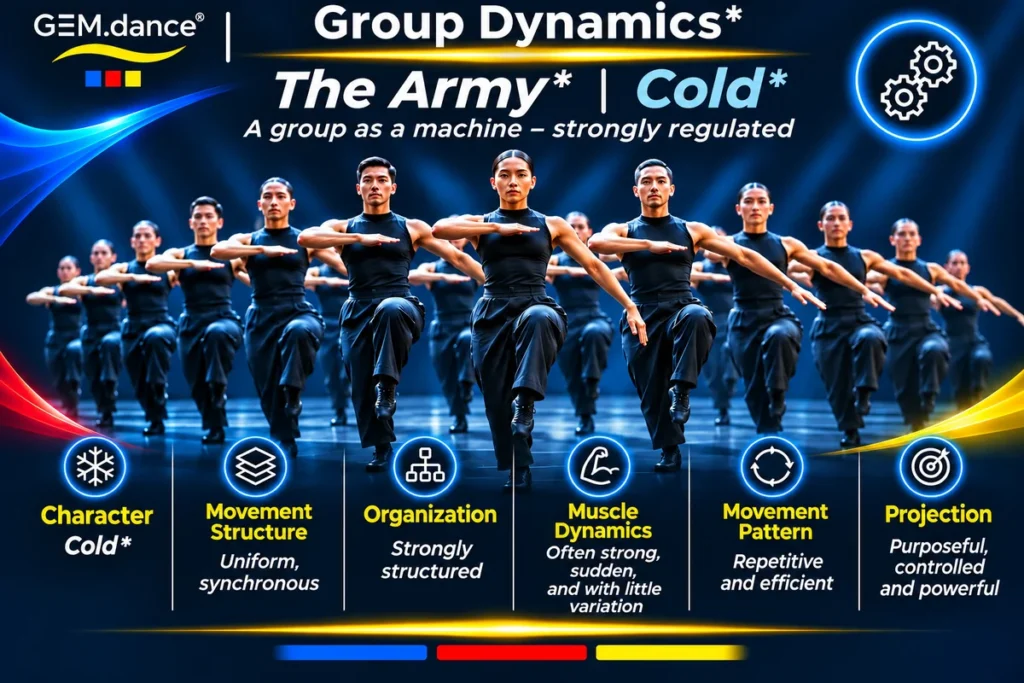
1. Training Like an Army (Automated Unification)*
This approach focuses on uniformity, a common requirement in competitive sport and in some synchronised theatre choreography. The aim in training is to match the movements of each person’s 10 Major Movers* as closely as possible across the group. With repetition and practice, movement patterns can become increasingly automatic. The goal is a consistent, uniform performance of the shared choreography.
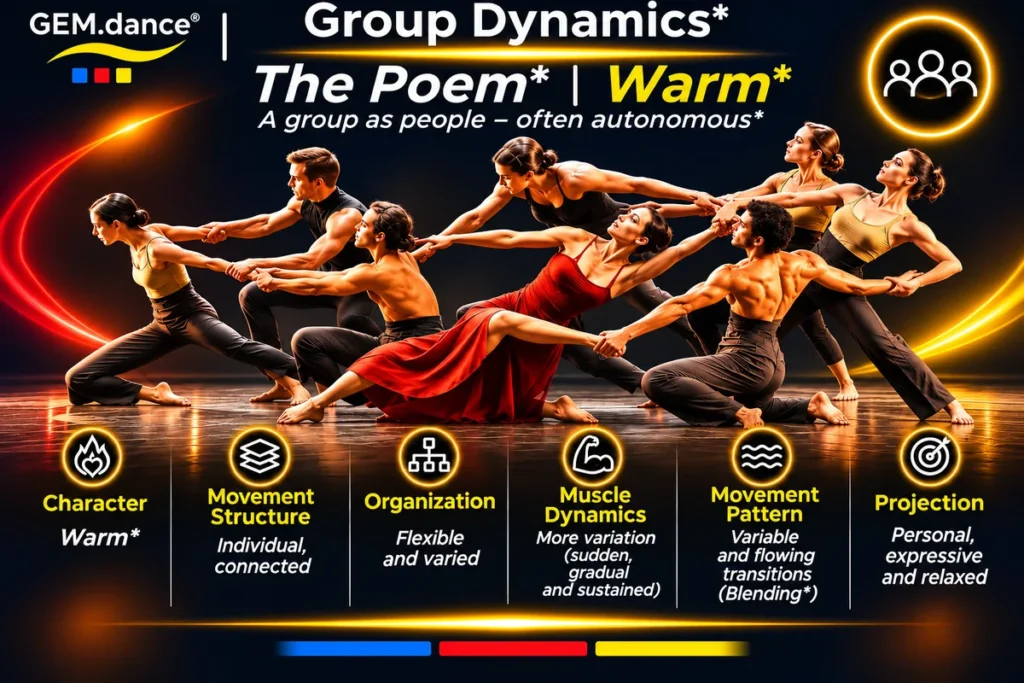
2. Training Like a Poem (Somatic Autonomy)*
This approach focuses on individual expression within a shared composition, as is common in many forms of theatre and partner work. It emphasises conscious Body Awareness and Embodiment*. The practitioners use External Perception* to coordinate how they travel together and follow the choreographic structure. At the same time, each person can continue to perceive and regulate their own movements. Within the agreed structure of the shared choreography, each practitioner can apply their own Muscle Dynamics Blending* to the three-dimensional Weight Actions* in the moment.
3. WHEN & WHY (The Collective Breathing Cycle)
The GEM model explores the collective breathing cycle as one way dancers might coordinate at a physiological level. When practitioners use the MT Switch* to direct their attention towards the inner dialogue*, they can pay closer attention to their breathing, bodily signals and coordination with one another.
Breathing (inhalation, retention* and exhalation) provides a rhythmic reference for shared movement. In training, dancers can use it to practise coordination and moving together as a group. The GEM Method explores the relationships between breathing, muscle tension, Vascular Tone* and movement dynamics while allowing for individual differences in how dancers respond physically to shared breathing.
The GEM model explores this approach from three perspectives.
- Neural Synchrony. Coordination between dancers is explored through perceptible signals, such as hearing and seeing movements, feeling contact and recognising the group flow*.
- Collective Acoustic Absorption*. The dancers’ Joint Chains* and movement strategies are explored in relation to their Landing* on the supporting surface. An external observer may hear the resulting sounds as more or less muffled depending on factors such as how the movement is performed, the supporting surface and the acoustics of the surroundings.
- Fluid Spacetime*. Transitions between formations are explored through continuous movement paths and each practitioner’s Blended Forms*. The focus is on how individual movements connect within the shared choreography and how they can be perceived as one continuous whole.
4. WHO IS IT FOR? (The Target Group)
This platform is intended for athletes, dancers and artists who want to learn to perceive and regulate their own physical Expression*, develop further or rediscover their movement possibilities in group or partner work.
The GEM Method also gives coaches, choreographers and therapists a framework for systematically observing, describing and analysing how muscular activity and sensory perception work together within a dance couple or formation.
5. THE AIM (5D Direction)
Within the GEM model, the aim is to use the Somatic Director* (5D / conscious awareness within the GEM model) to develop collective movement from the reproduction of learned patterns into a form of biological expression that dancers consciously perceive and support through their own bodily processes.
In practice, you learn to reproduce the choreography while consciously regulating your movements through your own bodily signals and breathing. You aim to retain your individual identity and bodily independence (Somatic Autonomy*) in the moment.