The human body as an architectural structure…
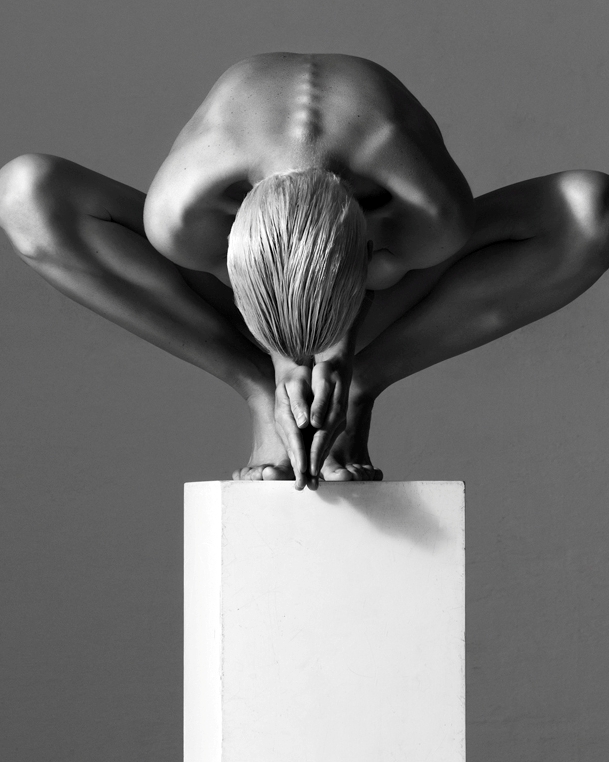
The human body possesses a specific structure. This form influences physical development from the embryonic stage to the present moment in life. The defining characteristic of form is its continuous change; the structure is permanently in motion. This process is observable in a wave rolling through the sea, a flame shifting in the air, or the human body in action.
Dancers paint figuratively with their limbs within the three-dimensional space (3D*); their body is the paintbrush and spacetime (4D*) is their canvas. The successive movements form lines and compositions in the air.
Within the three-dimensional space (3D*), the position of the body is analyzed using three fixed, geometric axes:
- The Vertical axis (Height / Linear)
- The Horizontal axis (Width / Lateral)
- The Sagittal axis (Depth / Sagittal*)
No opinion, culture, or taste is connected to these spatial pathways; it is pure, universal mechanics. Within the G.E.M. method, the physical structure is subdivided into 10 primary, analyzable body parts to create a continuous flow of forms along these axes. These segments are defined within spacetime (4D*), adding the factor of time to the three physical axes. Form within dance is a living composition; a fluid succession of moments.
Structure, exploration, and transformation
As a fundamental element of art, Form refers to the three-dimensional structure and organization of movements and patterns within a dance. This form can be explored, experienced, and discovered within body awareness through three oppositions:
- Singular* versus Composed* (The isolation of one or more individual body parts versus the composed movement of multiple body parts)
- Geometric versus organic
- Symmetrical versus asymmetrical
Proprioception* & Interoception*:
The Control and Source of the 10 Body Parts
The control or determination of this process occurs through proprioception* the internal body awareness that functions as the compass for the positioning and displacement of the limbs. Through targeted proprioceptive perception, the 10 specific body parts are consciously directed within spacetime (4D*).
The source of purposeful, conscious repetition originates from interoception* (the internal sensory perception of feeling). This perception forms the foundation for consciously experiencing physical action. By utilizing proprioception and interoception collectively, the ability arises to factually reposition the physical structure and break automatic patterns.
The perception and impact of Form shifts continuously from internal interoception* (conscious feeling) to exteroception* through external feedback instruments:
- The Mirror: Provides a direct, two-dimensional reflection.
- The Video / External Person: Registers the three-dimensional form from a specific camera angle or viewpoint.
- The Perspective (Spacetime): The standpoint from which the movement is observed determines how the form impacts the spectator, the coach, or yourself. It makes a fundamental difference whether a movement is viewed from a top-down view (helicopter view), frontally, or from the side.
Although a form remains physically constant, its perception transforms completely depending on the camera positioning or the coach’s viewpoint. A top-down view (helicopter view) exposes the geometric patterns and displacement across the floor, whereas a frontal or side view emphasizes the vertical axes, the angles of the 10 body parts, and the depth (sagittal axis). The chosen standpoint determines the actual data received.
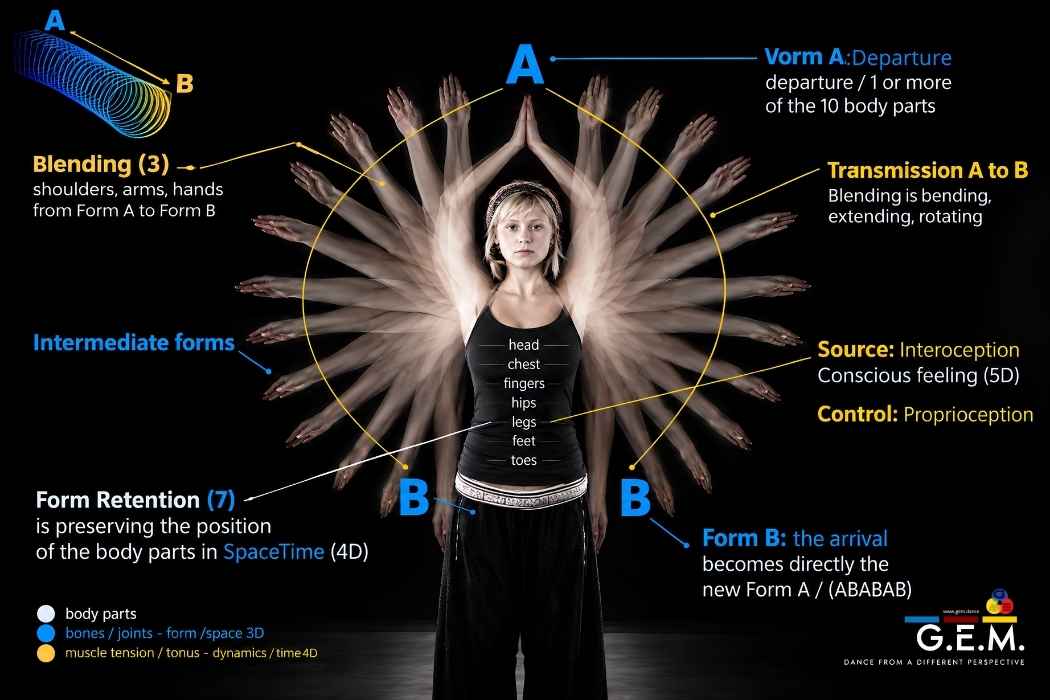
The Transmission from Form A to Form B: ABABAB
This ABABAB process is the mechanical motor that continuously operates within the 10 specific body parts, directed by proprioception*. Whether specific body parts are isolated or multiple parts move in a composed manner, each segment independently or collectively follows this sequential ABABAB transmission within spacetime (4D*). An unconscious interruption of this process causes a form break or an unconscious intermediate form.
- Form A (The Departure): The moment of departure of one or more of the 10 body parts.
- Form B (The Arrival): The point of arrival of those specific body parts.
As soon as the arrival is reached, the movement immediately transforms further. Form B becomes the new Form A for the next action. This creates an uninterrupted, fluid chain of successive form changes within the 10 body parts.
 Read more about proprioception here