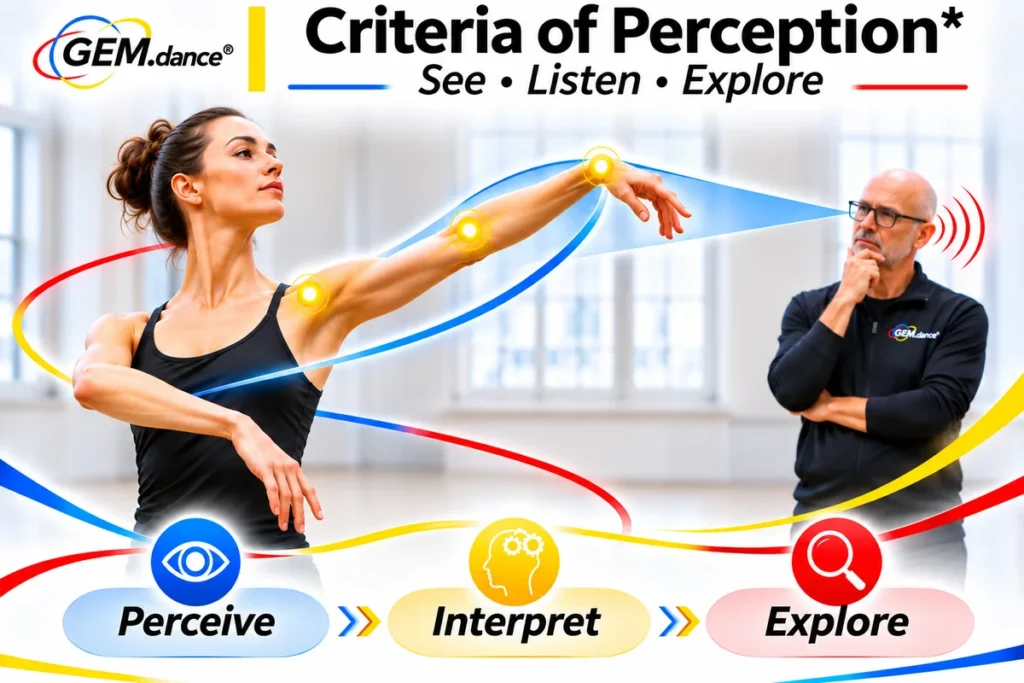
Criteria of Perception* (Physical Measurement Points)
What the trained external observer registers through sight and hearing
GEM Core* — From Automatism to Autonomy
The GEM Method* is a Somatic Lifestyle*, a way to use your body
and move with greater awareness throughout the day.
What you are unaware of lies outside your conscious control.
What you discover opens up possibilities for further growth.
Exploring the GEM Method* and its terminology can change how you see
your body, your movements and perhaps even life itself.
Think of yourself as an artist. Your body is your instrument,
the brush with which you move and express yourself.
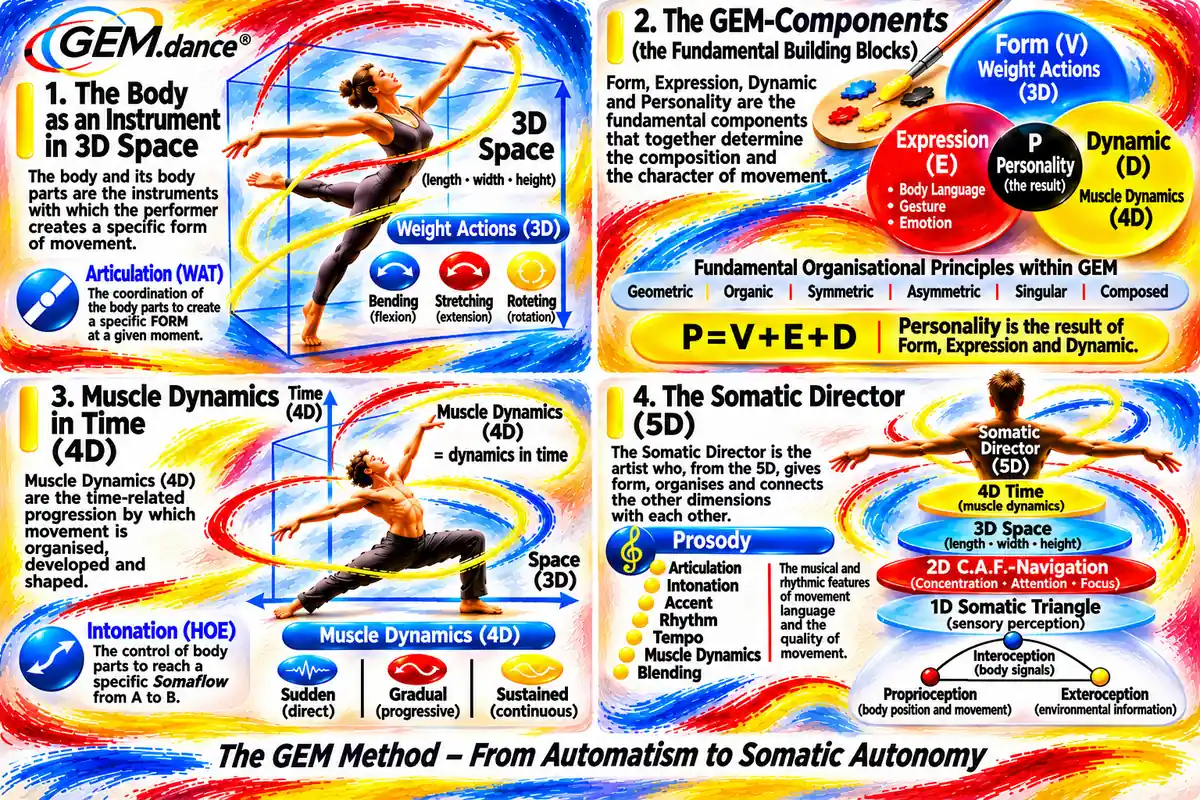
Each GEM colour represents an element of the method.
- 🔵 Blue — Form
- 🔴 Red — Expression
- 🟡 Yellow — Dynamic
- ⚫️ Black — Personality
Spacetime* is your canvas. Every movement gives
shape to space. You can explore this consciously while dancing,
playing sport, working, making art or going about your daily activities.
The GEM Method guides your development from Automatism to Autonomy.*
By becoming more aware of your body and movement, and by learning to
understand and organise them, you develop more ways to make your own
movement choices. As you move, you are the artist who shapes space
with your own body.
WHAT (The System)
Within the GEM Method*, the Criteria of Perception* form a system for exploring human movement through external observation and bodily perception.
The GEM Method* uses various components and concepts, including Weight Actions*, Muscle Dynamics*, Muscle Dynamics Blending*, Blended Forms*, C.A.F. Navigation* and the Somatic Triangle*.
These components offer different ways to perceive, describe and analyse movement. Together, they support the development of Movement Awareness* and Somatic Autonomy*.
HOW (The Observer’s Measurement Points)
The trained observer examines the practitioner’s performance as it happens, using six specific physiological parameters.
1. Somatic Autonomy (Bodily Independence / Direction of Gaze)*
The external observer explores how far the practitioner can consciously perceive and direct their movement using Internal Perception* (interoception* — 1D) and Body Awareness* (proprioception*), under the direction of the Somatic Director* (5D). The Movement Matrix* (the Movement Alphabet*) provides a framework for recognising different movement possibilities and applying them deliberately.
The practitioner’s knowledge, familiarity with the terminology and movement experience all play a role, as do the external guide’s expertise and experience. Do both understand each other’s language and instructions? The guide adapts the terminology and explanations to the practitioner’s knowledge and experience. This gives the practitioner mental space to pay attention to their body and how they perform the movement.
Direction of Gaze also gives the external observer a visible point of reference. During an automatic movement pattern, the practitioner’s gaze may shift without conscious intent to an external reference point, such as a mirror or the floor. This may be associated with uncertainty or a need for external visual information.
When consciously directing movement, the practitioner can rest their gaze on a fixed point while staying relaxed and aware of their surroundings. Within the GEM model, this is consistent with movement organised from Internal Perception* (interoception* — 1D) and carried out in the surrounding space.
Visual Deactivation* (closing the eyes) can also be used in training to explore how the practitioner senses internal bodily signals (interoception* — 1D) while moving.
Movement Organisation in Spacetime* (Form 3D — Dynamic 4D)
The external observer explores how the practitioner organises and performs movements of one or more body parts in spacetime*.
The observer examines how Weight Actions* (3D), Muscle Dynamics* (4D), Form Blending*, Form Retention*, Muscle Dynamics Blending* and Blended Forms* work together. These components are part of the full movement process known in the GEM Method as Somaflow*.
The 10 Major Movers*
The GEM Method distinguishes ten groups of body parts known as the 10 Major Movers*.
- Head
- Shoulders
- Ribcage
- Arms
- Hands
- Fingers
- Pelvis
- Legs
- Feet
- Toes
Each Major Mover* can move independently or in combination with other body parts. The external observer examines which body parts move, which retain their form and how their movements relate to one another in time and space.
Weight Actions* (3D) — Form
Within the GEM Method, Weight Actions* describe three basic movements.
- Bending (flexion)*
- Extending (extension)*
- Rotating (rotation)*
These Weight Actions* can take place separately, simultaneously or in sequence. The external observer examines how the practitioner uses them and how they change the position and form of the body parts.
Form Blending* and Form Retention*
During movement, body parts can change form or retain their existing form.
Form Blending* describes how different forms are combined and how one form transitions into another during movement. Form Retention* describes how a particular form is maintained throughout a movement or part of it.
Both processes can take place at the same time. For example, one body part can change form while another retains its form. The external observer examines how these processes are used within the overall organisation of the movement.
Floor Pathways* and Air Pathways*
The 10 Major Movers* can follow different movement pathways. Floor Pathways* describe the routes a body part follows while in contact with the floor. Air Pathways* describe the routes it follows through space without contact with the floor.
Each body part can follow its own pathway. The pathways can be followed simultaneously or in sequence and can change during the movement. The external observer examines how the pathways develop in spacetime* and how they relate to one another.
Muscle Dynamics* (4D) — Dynamic
Within the GEM Method, Muscle Dynamics* describe how the execution of movement develops over time. The method distinguishes three basic forms.
- Sudden* — a sudden change in the way the movement is performed.
- Gradual* — a change that develops over a period of time.
- Sustained* — continuing to perform a movement over a period of time.
The external observer examines how these Muscle Dynamics* are used and how they change within a single movement or between successive movements.
Muscle Dynamics Blending* (4D)
Muscle Dynamics Blending* describes how the three Muscle Dynamics* — sudden, gradual and sustained — are combined. These combinations can occur within one body part or across different body parts. The external observer examines how the Muscle Dynamics follow one another, overlap or combine during the movement.
Blended Forms* — Movement Forms and Texture
Within the GEM Method, Blended Forms* arise from combining Weight Actions* (3D) with Muscle Dynamics Blending* (4D).
Examples of Blended Forms* include Swing*, Impulse*, Bounce* and Vibration*.
The external observer examines how these Blended Forms* are performed and what visible changes occur in form, dynamics, direction and how the movement unfolds over time. In this criterion, Texture* refers to the observable characteristics of that dynamic execution.
Somaflow* — The Full Process of Movement Continuity
Within the GEM Method, Somaflow* describes the full process of movement continuity across the 10 Major Movers*, individually and in combination. Each body part can follow its own Floor Pathway* or Air Pathway*. The process involves Weight Actions* (3D), Form Blending*, Form Retention*, Muscle Dynamics* (4D) and Muscle Dynamics Blending*.
These processes can take place simultaneously or in sequence and can produce different Blended Forms*. Somaflow* encompasses how all these components work together throughout the movement.
The ABABAB Principle — Starting and Arrival Points
The ABABAB principle describes the sequence of starting and arrival points in continuous movement.
A body part moves from a starting point (A) to an arrival point (B). The position it reaches then becomes the starting point for the next movement.
A → B → A → B → A → B → …
The letters A and B mark the successive roles of starting and arriving as the movement unfolds. Each Major Mover* can follow its own pathway, change or retain its form, and move with its own dynamics. The 10 Major Movers* can do this independently, simultaneously or in different sequences.
Form Break* — An Interruption in Movement Continuity
Within the GEM Method, a Form Break* describes an interruption in Somaflow* while the practitioner uses Weight Actions* (3D), Form Blending*, Form Retention* and Muscle Dynamics Blending* (4D).
The external observer looks for possible Form Breaks* while the practitioner carries out a movement task involving one or more of the 10 Major Movers*. When comparing conscious and automatic movement control, the observer examines how many Form Breaks* they notice, when they occur and which Major Movers* are involved. The comparison takes into account the observer’s knowledge and what they are able to perceive. Within the GEM Method, two ways of performing the movement are distinguished.
- Conscious movement control. The practitioner directs their attention to how they perform the movement task. The GEM model predicts fewer Form Breaks* under these conditions. Form Breaks* can still occur.
- Automatic movement control. The practitioner performs the movement without continuously paying conscious attention to its individual components. The GEM model predicts that more Form Breaks* may occur under these conditions.
The external observer examines the number, timing and location of Form Breaks* during Somaflow*. Performing movement tasks while directing attention in different ways makes it possible to explore differences in movement continuity.
Individual Performance
How Somaflow* is organised and performed can vary from person to person. The same person may also vary their pathways, Weight Actions*, changes in form, Muscle Dynamics Blending* and Blended Forms* from one performance to the next. The external observer therefore examines the movement as performed, leaving room for variation in the movement pattern.
The Criterion of Perception
The external observer examines how the 10 Major Movers* follow their Floor Pathways* and Air Pathways* and how Weight Actions* (3D), Form Blending*, Form Retention*, Muscle Dynamics* (4D), Muscle Dynamics Blending* and Blended Forms* relate to one another throughout Somaflow*. The observer distinguishes what they perceive directly from what can be explored further.
3. Physical Preparation (Strength, Mobility and Force Transfer)
The external observer examines how the practitioner develops and prepares the body as a physical instrument for a range of movements and physical demands.
Strength Development
The GEM Method distinguishes and explores several types of strength. The yellow Strength Pyramid* shows these, including starting strength, explosive strength and strength endurance. By training different types of strength, the practitioner can develop the body’s physical capabilities and its ability to tolerate physical loads.
Mobility
Mobility* also plays an important role. Developing and maintaining movement at the joints and in individual body parts supports freedom of movement and the ability to perform a range of movements. Strength and mobility complement each other.
Force Transfer and Joint Chains*
The external observer examines how joints work together like links in a chain (Joint Chains*) and how forces and movements pass from one joint to the next. Examples include the shoulder, elbow and wrist working together, or the hip, knee and ankle. The observer looks at how the moving body parts relate to one another and how their actions are timed. Several joints can work together to produce one coordinated movement.
Developing strength and mobility and exploring how joints work together can help prepare the body for future physical challenges. This may also be relevant when preparing to return to training or supporting recovery after a medical procedure. Preparation and recovery needs vary with the person and the circumstances.
Preparing the Body for the Future
By training different types of strength and developing Mobility*, the practitioner builds physical capacity and reserves. This preparation can help maintain and expand movement possibilities and may be relevant to future physical challenges, a return to training or recovery after illness or a medical procedure. Starting from a higher level of physical capacity may offer advantages. Recovery also depends on the individual, the medical circumstances and the nature of the physical demands.
Scientific Evidence on Physical Preparation for Recovery
Research also points to potential benefits of physical preparation before surgery. A systematic review with network meta-analyses published in The BMJ in 2025 included 186 randomised trials with 15,684 participants. The findings suggest that exercise before surgery may reduce postoperative complications, shorten hospital stays and improve physical recovery.
The authors noted that the certainty of the evidence was limited for several outcomes. The findings suggest that developing and maintaining physical capacity before surgery may offer benefits during recovery. McIsaac et al., The BMJ (2025)
4. Acoustic Absorption (Hearing and Somaflow)*
The external observer listens to the sounds produced when the practitioner lands after a jump or rolls across the floor.
The observer pays attention to how loud the sound is, how long it lasts and when the body makes contact with the supporting surface.
The observer combines what they hear with what they see of Somaflow*, Weight Actions* (3D), Muscle Dynamics Blending* (4D) and how the Joint Chains* work together.
The sound can provide a starting point for exploring how the practitioner uses Body Awareness* (proprioception*) to direct, slow and continue the movement.
The external observer distinguishes what they perceive directly from what they can investigate further. The sound of contact is one source of information. Considered alongside the visible movement, it can help the observer explore how forces are distributed, how the movement is controlled and how Somaflow* is performed.
4. WHEN & WHY (Blind Choreography*)
During studio training, you activate C.A.F. Navigation* when performing Blind Choreography*.
With Visual Deactivation* (closing your eyes) or Auditory Deactivation* (using hearing protection), you limit external sensory input as much as possible. This includes visual reference points, external rhythms and sounds in your surroundings. Your attention shifts towards information you can sense through your own body, such as bodily sensations and contact with the floor.
As you navigate spacetime*, you use C.A.F. Navigation* to apply Concentration, Attention and Focus deliberately while moving. This framework helps you explore, step by step, how the Context*, the sensory information still available to you and your own movement choices relate to one another.
3. WHEN & WHY (Objective Evaluation)
The Criteria of Perception* in the GEM Method can be applied wherever human movement takes place. They help you observe, describe and explore movement systematically while leaving personal judgements open.
WHEN — The Internal and External Observer
The internal observer explores their own movement through Body Awareness* (proprioception*), signals from within the body (interoception*) and sensory information from the surroundings (exteroception*).
The external observer explores another person’s movement through features they can see and hear. What the observer recognises and registers depends in part on their knowledge of the GEM Method, their command of GEM terminology, their experience and the conditions under which they observe. Even an experienced observer can miss some movement features.
WHY — Objective Evaluation
GEM terminology helps distinguish personal judgements, such as beautiful or ugly, from observable features of movement.
The evaluation has three parts.
- Observe. What do you see, hear or experience from within?
- Interpret. What might explain what you observed?
- Investigate. What further observation or movement task could provide more information?
From Observation to Movement Control
The information gathered can be used to design targeted movement tasks. By repeating and observing the movements, you can explore changes in movement organisation, Somaflow* and the number of observed Form Breaks*.
The evaluation distinguishes between what happens during the movement and what the internal or external observer actually registers.
4. WHO IS IT FOR? (The Target Group)
The Criteria of Perception* in the GEM Method are intended for anyone who wants to observe, understand and explore human movement. They can be used by dancers, teachers, coaches, choreographers, artists, therapists, people undergoing rehabilitation and others with an interest in movement.
The internal observer uses the criteria to explore their own movement. The external observer uses them to observe and discuss other people’s movements. How the criteria are applied depends in part on knowledge of the GEM Method, familiarity with its terminology and experience in observing movement.
The criteria provide a shared language for describing movement features and exchanging information while leaving personal judgements open.