💡 GEM Core* — From Automatism to Somatic Autonomy*
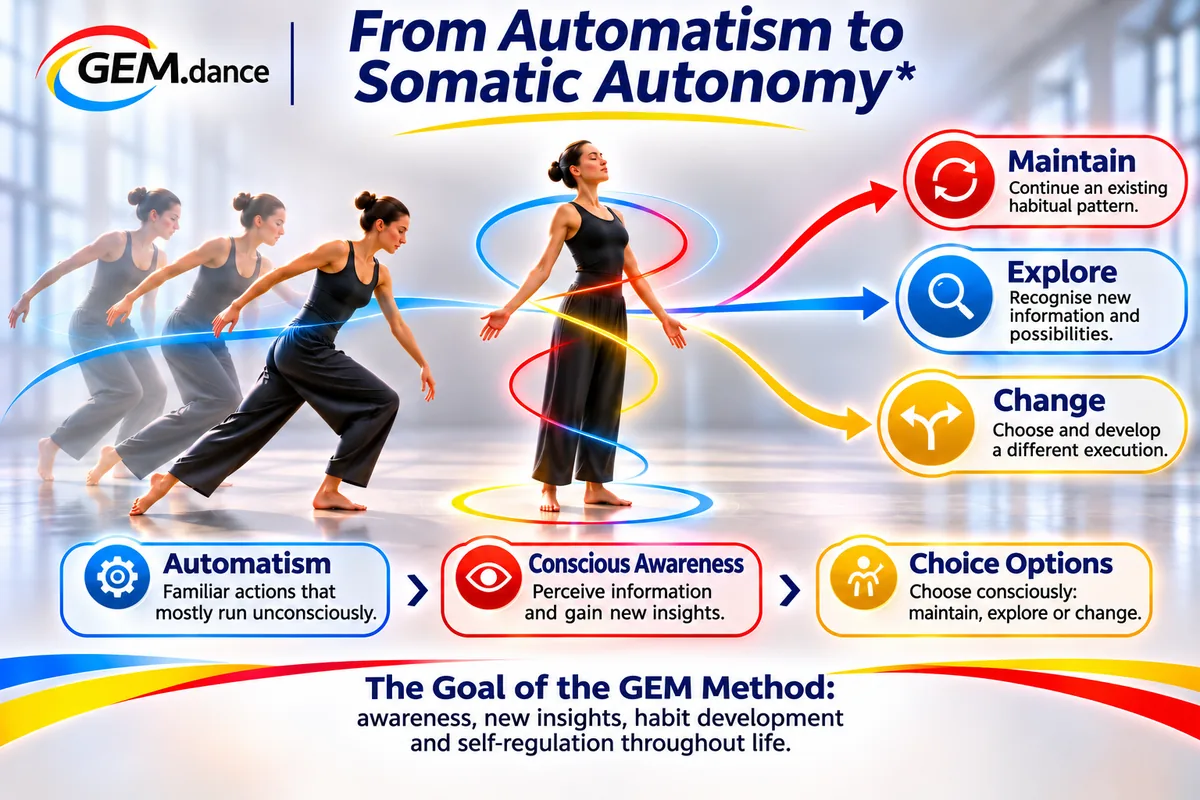
Throughout life, people develop habits and automatic actions that help them function in everyday life. By paying conscious attention, they can notice new information and gain new insights. Becoming aware of a habit and changing it are separate steps. A person can choose to keep, explore or adapt an existing habit.
The GEM Method offers concepts, models and tools for exploring this process. The Somatic Triangle* helps people perceive information from their body and surroundings. The Somatic Director* (5D) describes how they can use this information to make conscious choices and regulate their own actions.
Within the GEM Method, Somatic Autonomy* means developing conscious perception, expanding the choices available to you and learning to regulate your own actions.*
The aim is to be able to choose consciously when to change a habit.
THE AIM (5D Direction)
The Criteria of Perception* in the GEM Method are used to explore human movement and Body Awareness* before forming a judgement. They help the practitioner develop conscious control of movement through the Somatic Triangle*.
- Interoception — sensing signals from within the body.
- Proprioception — sensing your own posture and movement.
- Exteroception — sensing information from your surroundings.
The Somatic Director (5D)* uses this information to consciously perceive, explore, organise and direct movement. This supports the development of Somatic Autonomy*, the ability to perceive, organise and direct your own movement independently.
6. Awareness and Development (The Four GEM Processes)
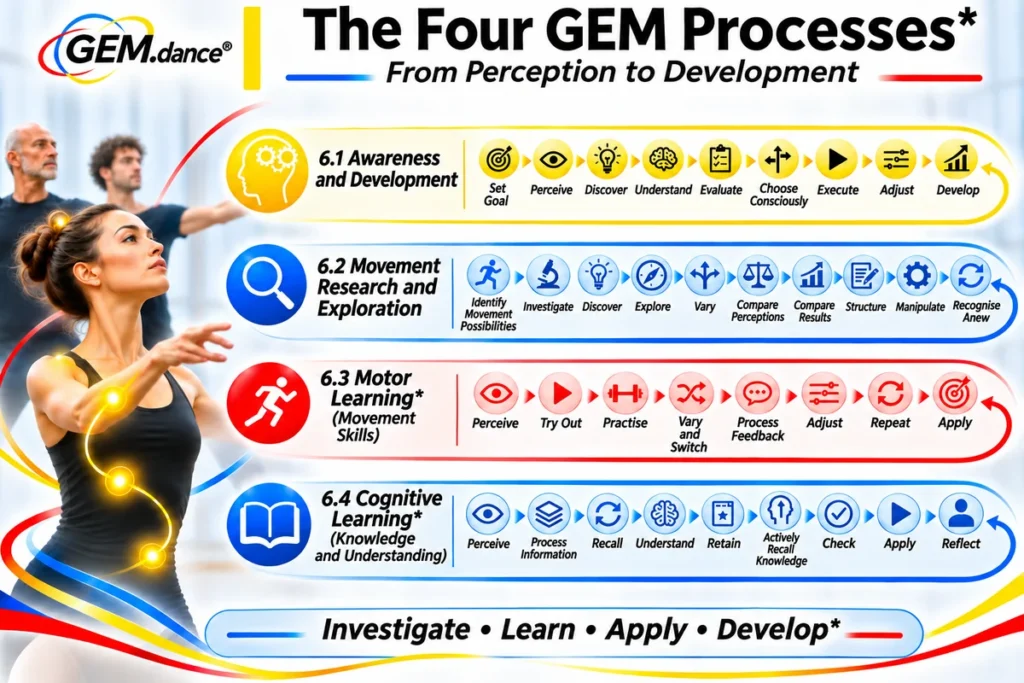
In the GEM Method, the body, thinking, perception and behaviour influence one another as awareness develops. The four GEM processes below describe how practitioners can perceive, explore, practise and understand movement. Through MT (Micro-Training)*, they can explore and practise how they use perception and knowledge to direct movement in everyday activities.
The arrows in the sequences show one possible order. Activities can overlap and occur in a different order. Perception, practice, feedback and repetition can help people adapt existing habits and develop new ones.
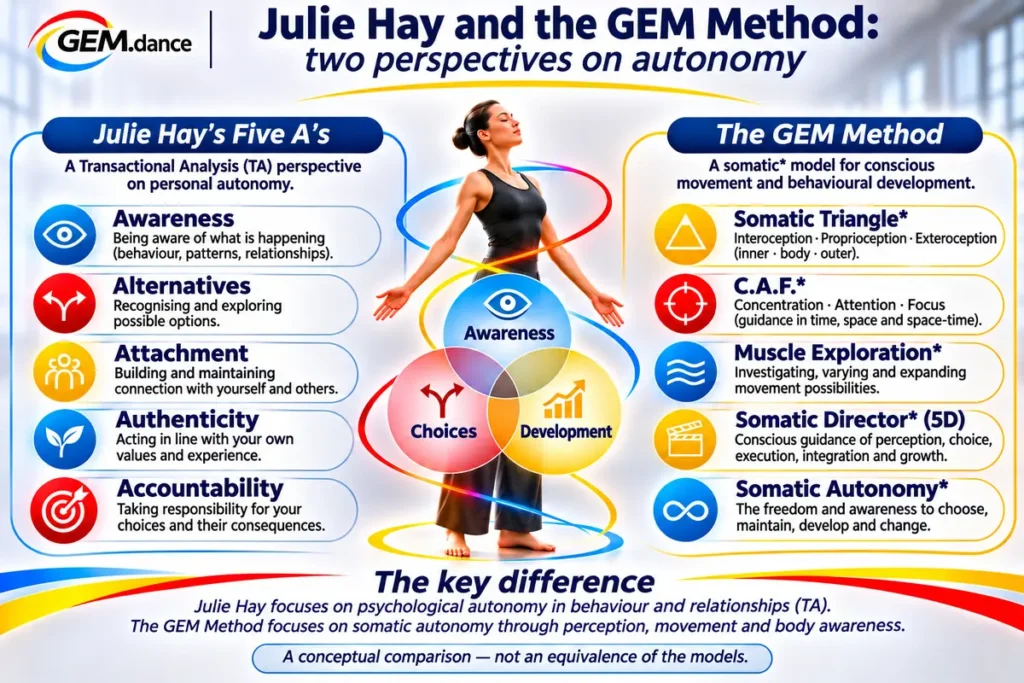
The Somatic Triangle* brings together the perception of signals from within the body (interoception), the posture and movement of the body (proprioception), and information from the surroundings (exteroception).
The Somatic Director (5D)* uses this information to consciously perceive, explore, organise and direct movement.
With MT (Micro-Training)*, practitioners can explore and practise how they use perception and knowledge to direct movement in everyday activities.
Within this framework, the GEM Method provisionally identifies four processes.
- Awareness and Development
- Movement Research and Exploration
- Motor Learning (Movement Skills)*
- Cognitive Learning (Knowledge and Understanding)*
These processes can influence one another, overlap and occur in different sequences.
Within these processes, practitioners explore self-regulation, habit formation and automaticity as aspects of how behaviour and movement are directed consciously and automatically. Perception, knowledge, practice, feedback and repetition can help people adapt existing habits and develop new ones.
6.1 Awareness and Development
Set a goal → Perceive → Discover → Understand → Evaluate → Choose consciously → Carry out → Adapt → Develop ↻
6.2 Movement Research and Exploration
Explore movement possibilities → Investigate → Discover → Explore → Vary → Notice differences → Compare results → Record → Manipulate → Explore again ↻
6.3 Motor Learning* (Movement Skills)
Perceive → Try out → Practise → Vary and alternate → Process feedback → Adapt → Repeat → Apply ↻
6.4 Cognitive Learning* (Knowledge and Understanding)
Perceive → Process information → Repeat → Understand → Remember → Actively recall knowledge → Check → Apply → Reflect ↻
6.5 Common Principles of Human Development
The Aim
This section gives readers knowledge and practical tools for consciously exploring their own physical, sensory, cognitive and behavioural development.
The seven principles show the roles that concentration, attention, motivation, repetition, feedback, physical activity and recovery can play in learning and development.
By learning about and applying these principles, practitioners can explore their habits, notice differences and make conscious choices that suit their abilities, activities and goals.
6.5.1 Concentration, Attention and Focus (C.A.F.)
What Is C.A.F.?
In the GEM Method, Concentration, Attention and Focus (C.A.F.) are used to consciously explore how people perceive and process information and organise their activities.
C.A.F. can be used in physical, sensory, cognitive and behavioural activities such as listening, looking, feeling, discovering, reading, learning, moving and communicating.
The Three Concepts and How They Relate
Each concept has its own function and relates to the other two.
- Concentration (Time) — engaging deliberately with an activity, subject or task for a period of time.
- Attention (Space) — directing perception towards one or more elements, people, objects, events or sources of information.
- Focus (Spacetime) — directing perception towards a specific detail, element or event at a particular place and time.
Flexible Order
Concentration, Attention and Focus can occur at the same time, influence one another and change during an activity.
Depending on the situation, a person can start with Concentration, Attention or Focus. The order can vary.
The Aim
C.A.F. helps practitioners consciously explore and organise three aspects of an activity.
- How long they spend on the activity (Time).
- What they direct their perception towards (Space).
- Which specific detail or event they explore at a given moment (Spacetime).
This allows practitioners to explore how Concentration, Attention and Focus are used individually and together.
How Can C.A.F. Be Applied?
Example 1 — Reading a Text
- Concentration — spend a period of time working with the text.
- Attention — notice different words, sentences and sections.
- Focus — examine one specific word or detail at a given moment.
Example 2 — Listening to Music
- Concentration — listen to a piece of music for a period of time.
- Attention — notice different instruments, sounds, rhythms, accents and musical patterns. You can also direct your attention to the bars and beats within a rhythm.
- Focus — listen closely to one sound, beat, accent or musical change at a specific moment.
By listening consciously and counting along if useful, you can explore the musical information available to you and choose which elements to use as the piece plays.
Example 3 — Exploring a Movement to Music
- Concentration — spend a period of time performing or exploring a movement in relation to the music.
- Attention — notice different body parts, movements, musical accents, rhythms and beats.
- Focus — explore how one detail of the movement coincides with a chosen beat, sound or musical accent at a specific moment.
You can consciously choose which musical information to use to begin, continue, change or end a movement. In all three examples, Concentration, Attention and Focus can be used in different orders or at the same time.
Evaluation and Development
The practitioner can explore the following questions.
- What am I directing my Concentration, Attention and Focus towards?
- How do they change during an activity?
- What information do I perceive?
- Which details do I notice?
- What choices can I make based on what I perceive?
- When do I want to adjust my Concentration, Attention or Focus?
The information gathered can help practitioners consciously explore how they perceive and process information, make choices and carry them out. They can then make adjustments where they wish.
6.5.2 Motivation, Discipline and Individual Differences
The Aim
The aim is to explore which personal characteristics and circumstances affect how people start, carry out and keep up activities.
Why Does This Matter?
Motivation can help people start and keep up an activity. Discipline and self-regulation can help them follow through on their choices and adapt their behaviour.
People differ in their prior knowledge, attention, pace of learning and the way they process information. These characteristics can vary with the situation and the task.
By noticing these differences, practitioners can explore which ways of learning, practising and working suit their own abilities and goals.
How Can This Be Applied?
The practitioner can explore the following questions.
- What helps me start an activity?
- What conditions support my concentration and attention?
- What helps me follow through on a choice I have made?
- When do I need to adjust the task, schedule or way of working?
- What changes can I observe through practice and repetition?
This information can be used to organise and evaluate activities consciously and to adapt them where needed.
6.5.3 Repetition, Self-Testing and Feedback
The Aim
The aim is to explore, check and further develop knowledge and movement skills. By recalling information from memory without prompts (retrieval practice), practitioners can check what they have remembered and understood.
Using Digital Tools
Flashcards, practice questions, research tasks and digital exercises can be used to explore and develop knowledge, perception, skills and behaviour.
Digital tools can present questions again, check answers, record experiences and track progress.
Photographs, video and audio recordings can be used to observe, compare and evaluate actions, movements, sounds and changes.
Practitioners can use this information to consciously organise their own learning, practice, exploration and adjustments.
6.5.4 Looping Back* and Knowledge Transfer
The Aim
The aim is to examine, understand, check and apply the information you have gathered and pass it on to others.
Why Does This Matter?
By revisiting information and explaining it in their own words, practitioners can check what they have understood, remembered and applied.
Explaining what you know to others can help you discover connections, deepen your understanding and identify questions that still need exploring.
How Can This Be Applied?
You can revisit and document the information you have gathered and explain it to others in your own words. When examining and sharing information, distinguish between three types of source.
- Primary sources — original research data or reports of original research.
- Secondary sources — publications that examine or analyse existing information.
- Tertiary sources — overviews and summaries of existing knowledge.
Podcasts, documents and AI can help you gather and compare information and explore it in greater depth or across a wider range of topics. Check the original sources and the accuracy of the information.
From Knowledge to Application
Within the GEM Method, practitioners can draw on what they have learnt when observing, investigating, performing and evaluating.
New questions and insights can prompt practitioners to revisit earlier information. The GEM Method calls this recurring process Looping Back*.
6.5.5 Habit Formation and Growth
The Aim
The aim is to consciously recognise and explore existing habits and adapt them when desired. This helps practitioners discover new possibilities and make conscious choices in movement, thinking and behaviour.
How Can Habits Be Changed?
- Observe. Identify which action or movement happens automatically.
- Investigate. Find out when, where and under what circumstances the habit occurs.
- Understand. Explore which cues, experiences and repetitions play a role.
- Choose consciously. Decide whether to keep or adapt the existing habit.
- Try it out. Perform a different action or movement.
- Repeat. Practise the chosen action regularly in suitable circumstances.
- Evaluate and adapt. Notice what changes and adjust how you perform the action as needed.
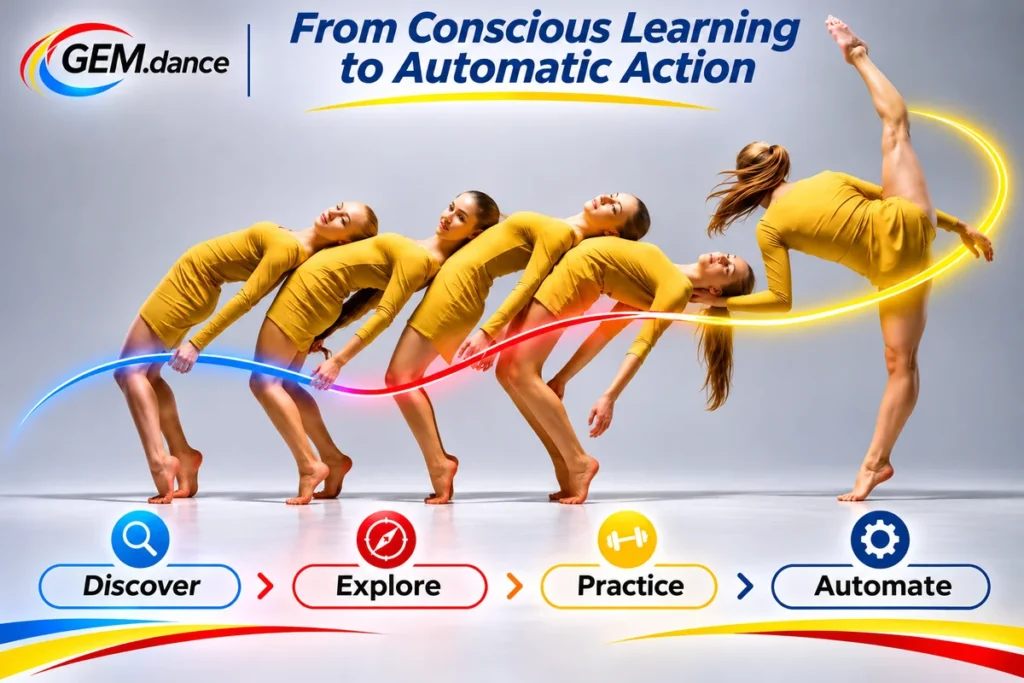
With repetition and use, new habits can form and gradually become automatic.
From Awareness to Development
Within the GEM Method, practitioners can use the Somatic Triangle* to perceive bodily signals, posture, movement and information from their surroundings.
The Somatic Director* (5D) uses this information to explore conscious choices and direct how movements are performed. New experiences, observations and insights can prompt practitioners to revisit existing habits and develop them further.
How Long Does Habit Change Take?
Developing new habits takes time and repetition. How long it takes varies with the person, the action and the circumstances.
In a study of everyday habits, the median estimated time to reach 95% of a person’s modelled level of automaticity was 66 days. Individual estimates ranged from 18 to 254 days. Lally et al. (2010)
These figures describe variation within the study. Changing an existing habit can follow a different course from forming a new one. Within the GEM Method, practitioners can explore how an action changes gradually through conscious perception, practice, repetition and adjustment.
The aim is to be able to consciously keep or adapt existing habits and develop new habits that fit your own goals.
Evaluating Habit Change
The time it takes to change a habit tells you how long the process lasted. Within the GEM Method, practitioners also explore four aspects of the change itself.
- Execution. How is the action or movement performed?
- Circumstances. When and in what situation does the action take place?
- Automaticity. To what extent does the action occur without conscious direction?
- Conscious choice. Can the practitioner recognise, retain or adapt the action when they wish?
The aim is to understand your own habits and explore the ways you can consciously direct them. This supports Somatic Autonomy*, the ability to perceive, organise and direct your own movement independently.
6.5.6 Autonomy in Behaviour and Relationships
Recognising a habit can give you room to choose consciously how you act. That choice also plays a role in how you interact with others. How can you adapt your own movement while continuing to notice what is happening between you and another person?
Applying the Five A’s in Everyday Life
Julie Hay’s Five A’s. You can turn each concept into a question to explore while dancing.
6.5.7 Time Allocation, Breaks and Alternating Rest with Activity
Learning, research and practice sessions can be spread out over time (spaced learning). Regular breaks give you time to recover and can help reduce fatigue.
Practical Guide
| Learning or Research Time | Break | Suggested Use |
|---|---|---|
| 20–25 minutes | 5 minutes | Short learning tasks and periods of focused concentration |
| 30–45 minutes | 5–10 minutes | Reading, writing and processing information |
| 45–60 minutes | 10–15 minutes | Longer research and practice sessions |
Active and Passive Breaks
During a break, you can choose between physical rest and activity.
An active break might involve walking, cycling, mobility exercises, gardening or household activities such as vacuuming, cleaning and cooking.
A passive break might involve sitting, relaxing or stepping away from the task for a short time.
Individual Differences and Flow
The need for breaks varies with the person and the activity. How absorbed you are in an activity (flow) can also influence when you choose to take a break.
The timings in the table are practical examples. The intervals that suit you may vary with the task and how you feel.
Scientific Evidence
Research indicates that short breaks can help reduce fatigue. Studies on interrupting prolonged sitting also report improvements in some measures of physical health.
Research on spaced learning supports spreading learning sessions over time. Within the GEM Method, you can explore how to alternate physical rest and activity in a way that suits your abilities, the task and your learning goal.
6.6 How the Processes Fit Together
Perceive → Discover → Investigate → Understand → Choose Consciously → Apply → Repeat → Learn → Grow ↻
This sequence summarises possible activities and outcomes within the four GEM processes. The activities can occur in different orders. Learning can take place at various points, and further development can prompt new observations and investigations.