Proprioception* (Form / Force — Body Awareness*)
The Movement Alphabet and the adaptation of physical habits
GEM Core: Proprioception* (Body Awareness*)
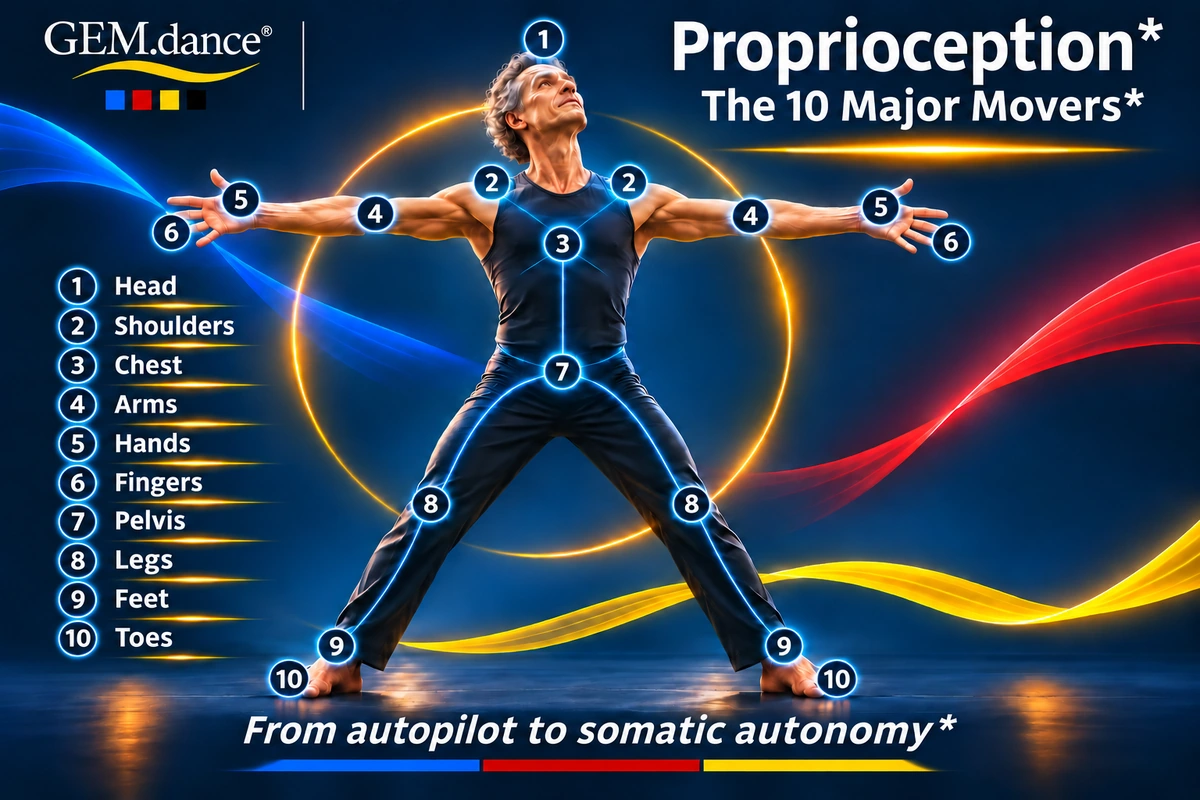
Within the GEM Method, Body Awareness* (proprioception*) refers to the biological sensory system that provides information about the position and movement of body parts.
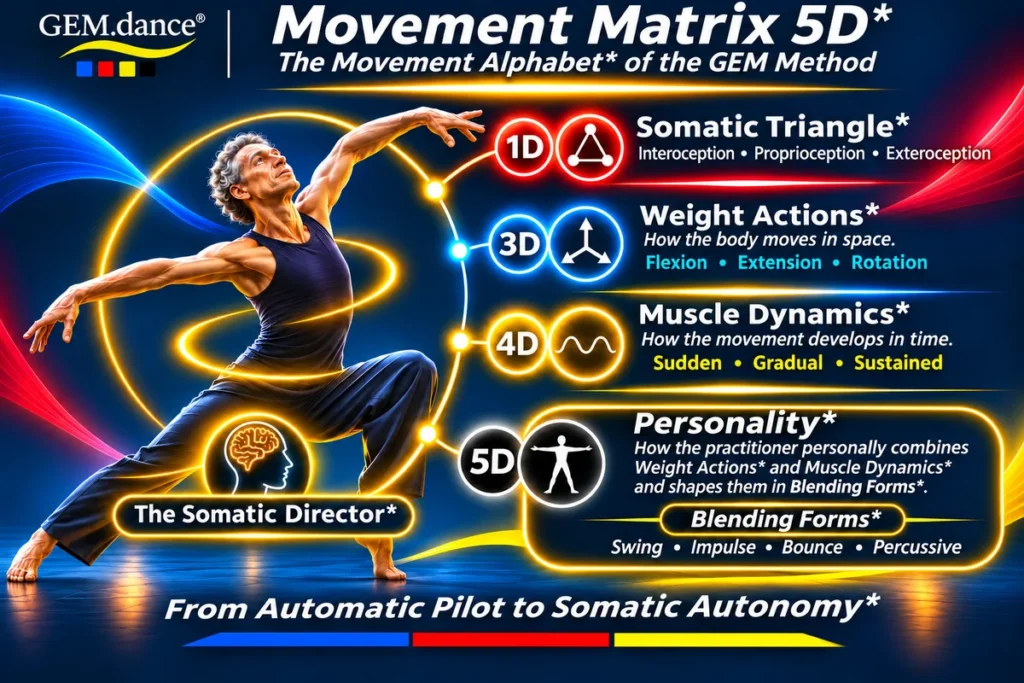
The GEM model uses this flow of information to explore movement through several interrelated components. It links Body Awareness* to Internal Perception* (1D — interoception*), the 10 Major Movers*, the three-dimensional Weight Actions* (3D), such as bending, extending and rotating, and the four-dimensional Muscle Dynamics* (4D), such as sudden, gradual and sustained. Together, these components form the overarching Movement Alphabet*.
1. WHAT (The System)
Body Awareness* (proprioception*) is the biological sensory system that provides information about posture and movement. This information comes from receptors in the muscles, tendons and joints. In the GEM Method, this information is linked to the three-dimensional Weight Actions* (3D), such as bending, extending and rotating, and the four-dimensional Muscle Dynamics* (4D), such as sudden, gradual and sustained.
Sound is perceived through External Perception* (exteroception*). Information from sound can be combined with information from Internal Perception* (interoception*) and Body Awareness* (proprioception*) as the Somatic Director* (5D) consciously directs movement. Acoustic Absorption* describes how materials absorb sound, for example through materials and surfaces in a room. The amount of absorption depends on the properties of the material and the frequency of the sound.
The Physical Carrier* is the body. The Movement Matrix* provides a structure for exploring the components of movement and how they relate to one another. Within the GEM Method, Evolution* describes the development from automatic habits towards greater independence (Somatic Autonomy*).
Visual anchor 🔵 Blue — the architecture of Form*.
2. HOW (The GEM Movement Matrix & the Movement Alphabet)
Within the GEM Method, the Movement Matrix* describes the relationship between joint mechanics, Weight Actions* (3D) and Muscle Dynamics* (4D), such as sudden, gradual and sustained.
Movement in spacetime* can be compared to a film. A film consists of individual frames that follow one another rapidly and give the impression of continuous movement. In this comparison, each frame represents an Event* during a movement.
The GEM Method uses an imaginary frame rate of 480 frames per second (480 FPS*) as part of the model. This figure helps you examine small differences in movement (Micro-nuances*) and their timing in detail. The frame rate is a metaphor that illustrates the GEM model. The biological functioning of the nervous system* is outside the scope of this comparison.
The GEM model links information about movement to the Somatic Triangle*, which comprises Internal Perception* (interoception*), Body Awareness* (proprioception*) and External Perception* (exteroception*). You use this information to direct movement consciously through the Somatic Director* (5D).
From a Single Frame to Movement Combinations
1. The Single Frame (3D — One Event)*
In the film comparison, a single still frame represents a snapshot of a movement. In this frame, the body parts are in particular positions and the joints are at specific angles. The Weight Actions* of bending, extending and rotating describe how the body parts move in relation to one another in space. Gravity and the supporting surface also play a role.
2. Playback Speed (4D — Multiple Events)*
When individual moments follow one another, they give the impression of continuous movement. Within the GEM Method, you explore how the Muscle Dynamics* shape the transitions between these moments.
The three primary Muscle Dynamics are:
- 🔴 Sudden — a rapid change in muscle tension.
- 🟡 Gradual — a change that develops over a longer period.
- 🔵 Sustained — muscle tension maintained for a period of time.
Combining these Muscle Dynamics through Muscle Dynamics Blending* produces different transitions and movement qualities.
3. Blended Forms (the Basic Families of the Movement Alphabet*)*
Within the GEM Method, Impulse*, Impact*, Swing*, Bounce*, Rebound*, Turning*, Jumping*, Shaking* and Vibration* are examples of basic terms in the Movement Alphabet*. Each term has its own meaning and describes a recognisable movement form or principle.
The structure below shows how Weight Actions* (3D) and Muscle Dynamics* (4D) can work together within these terms. The way each movement is performed can vary with the movement itself, the body parts involved and the Muscle Dynamics selected.
By exploring these terms individually and then combining them, you learn to recognise, distinguish and consciously use different movement forms.
The Basic Terms of the Movement Alphabet*
Impulse (The Initiation)*
- Definition. The initial transfer of energy or application of force that starts or changes a movement.
- How it works in 3D and 4D. In the GEM model, Impulse is explored in relation to a Weight Action* (3D), such as rotating or extending, and a sudden (🔴) or gradual (🟡) Muscle Dynamic* (4D).
- Movement example. Initiating an arm movement from the shoulder blade to start a swing.
Impact (The Collision)*
- Definition. The moment when a collision or landing occurs and external forces act directly on the body.
- How it works in 3D and 4D. In the GEM model, Impact is explored in relation to compression in the Joint Chains* (3D). This can occur alongside a sudden (🔴) increase in Muscle Tone* (4D) to absorb the forces.
- Movement example. Landing after a jump, with the feet and knees helping to absorb the landing forces.
Swing (The Swinging Action)*
- Definition. A pendulum-like movement that begins with a deliberate initiation and continues partly under the influence of momentum and gravity.
- How it works in 3D and 4D. In the GEM model, Swing is explored as a sequence of pendulum-like movements at the joints (3D). The movement begins with an active Impulse* and can lead into a gradual (🟡) Muscle Dynamic or a phase of reduced muscle tension (4D).
- Movement example. Swinging the leg forwards with force and then letting the lower leg continue to swing.
Bounce (The Springing Action)*
- Definition. A springing movement in which successive bending and extending help absorb forces and continue the movement immediately.
- How it works in 3D and 4D. In the GEM model, Bounce consists of rhythmic alternation between flexion (bending) and extension (straightening) in the lower Joint Chains* (3D), supported by a combination of sustained (🔵) and sudden (🔴) Muscle Dynamics* (4D).
- Movement example. Bending and springing back through the ankles and knees while repeatedly taking your body weight.
Rebound (The Return Action)*
- Definition. A movement back after an Impact*, in which the forces acting on the body and the body’s response influence the direction of movement.
- How it works in 3D and 4D. In the GEM model, Rebound describes a rapid reversal in the direction of movement at the joints (3D), combined with a quick transition to a sudden (🔴) Muscle Dynamic* that produces a push-off (4D).
- Movement example. The hand and arm springing back after making firm contact with a wall or partner.
Turning (The Rotation)*
- Definition. A rotation* around a joint axis or a body axis that begins and develops in spacetime*.
- How it works in 3D and 4D. In the GEM model, Turning primarily uses the Weight Action* of rotating at the joints (3D). It can be performed with a sudden (🔴) or gradual (🟡) Muscle Dynamic, or with a combination created through Muscle Dynamics Blending* (4D).
- Movement example. Turning the torso around the longitudinal axis of the spine to change the direction of your gaze.
Jumping (The Push-Off)*
- Definition. A movement in which the body actively pushes off the supporting surface, travels through the air and then lands.
- How it works in 3D and 4D. In the GEM model, Jumping requires coordinated extension through several Joint Chains* (3D), supported by a forceful, sudden (🔴) Muscle Dynamic* (4D).
- Movement example. Pushing off the floor with both legs so the body briefly leaves the supporting surface.
Shaking (The Shaking Action)*
- Definition. A repeated movement in which particular body parts move quickly and loosely back and forth to explore or deliberately change muscle tension.
- How it works in 3D and 4D. In the GEM model, Shaking consists of successive small Weight Actions* (3D), combined with a rapid, rhythmic alternation between sudden (🔴) Impulses* and phases of relaxation (4D).
- Movement example. Moving the hands and wrists loosely back and forth to sense the current Muscle Tone* in the arms.
Vibration (The Tremor)*
- Definition. A rapid repetition of very small variations in movement* or changes in tension that can be felt as a vibration in the tissue.
- How it works in 3D and 4D. In the GEM model, Vibration describes very small shifts in joint angles (3D), combined with a rapid alternation between sustained (🔵) and sudden (🔴) Muscle Dynamics* (4D).
- Movement example. Creating a fine vibration in the arm or the whole body by rapidly tensing and relaxing the muscles in succession.
3. WHEN & WHY (Symmetry, Asymmetry and Neural Control)
You use Body Awareness* (proprioception*) to explore automatic movement routines and deliberately vary them. The GEM Method trains this in two ways.
1. Symmetry and Asymmetry (Bilateral and Unilateral Movement)
- Bilateral movement. Both sides of the body are involved. The movement can be symmetrical when the left and right sides perform the same movement at the same time, or asymmetrical when they perform different movements or patterns.
- Unilateral and isolated movement. In unilateral movement, you use one side of the body. In isolated movement, you deliberately control individual body parts separately from others. The two can occur together in practice, and each has a distinct meaning within the model. The GEM Method uses both to explore Body Awareness* in detail and practise conscious control of movement.
2. From Neural Routines to Conscious Manipulation
Within the Movement Matrix*, the GEM Method distinguishes three phases. They describe how deliberately varying a learned movement structure (Quantity*) changes the texture of the movement (Quality*). Muscle memory is the everyday term for this type of learning. These routines become automatic through information processing in the nervous system*. In the GEM Method, Quantity* and Quality* have specific meanings within the model.
- Learned Routines (the Quantitative Structure). With repeated practice, movement patterns can become increasingly automatic in the nervous system*. You can perform these routines without consciously directing every component. In the GEM model, Quantity* refers here to the fixed form and extent of the existing routine as it is repeated.
- Muscle Exploration (the Qualitative Nuance). You consciously explore an existing routine. Using the C.A.F. Formula* (Concentration, Attention and Focus), you direct your attention towards Body Awareness* to discover Micro-nuances*. In the model, Quality* refers to exploring the texture and specific characteristics of how the movement is performed.
- Muscle Memory Manipulation (Deliberate Variation)*. You deliberately vary an existing movement routine. By purposefully changing movement components, Muscle Dynamics* (4D) and their timing, you learn to discover and apply new movement possibilities in spacetime*.
The GEM Method uses these phases to describe how you move from an automatic basic structure towards deliberate variation in movement quality and further development within the model.
4. WHO IS IT FOR? (The Target Group and the Development of Body Awareness)
This platform is designed for individual athletes, dancers and artists who want to consciously explore and regulate their physical Expression*, develop further or rediscover their movement possibilities. Coaches and therapists can also use the GEM Method to observe and analyse movement systematically.
Body Awareness* develops throughout life. From birth, people learn to process information from their own body and their surroundings. As they grow, gain movement experience, practise and undergo physical changes, their ability to perceive posture, movement and bodily sensations also changes. This development varies from person to person.
In the GEM Method, you deliberately explore and practise Body Awareness*. You can use Mobility Training* and targeted contact with body tissues to explore bodily sensations, for example with a small, firm ball under the sole of the foot or a foam roller* on the back and shoulders. During the exercise, you learn to pay attention to what you sense and how you perform the movement.
The GEM Method also provides terms and observation criteria for systematically exploring and describing Air Pathways*, Floor Pathways* and Joint Chains*. The aim is to give you and trained observers ways to recognise, explore and further develop movement possibilities with greater awareness.
5. THE AIM (5D Direction)
The Movement Matrix* helps you consciously explore and vary automatic motor routines so you can discover and develop new movement possibilities. Under the guidance of the Somatic Director* (5D / conscious awareness), you learn to move from repeating learned movement patterns towards greater Somatic Autonomy*, Fine Balance* and Embodiment* in the moment.
Proprioceptive* signals continually provide information about the position and movement of body parts, including the relative positions of bones and joints and how the muscles are working. This information contributes to the perception and regulation of movement. In the GEM Method, you explore how timing, Duration* and the organisation of forces together determine the specific characteristics of a movement.