

Interoception* (The Source / Energy — Internal Perception*)
GEM Core
Within the GEM Method, Internal Perception (interoception*) means sensing signals from your own body. The neuroscience literature describes the relationship between internal bodily signals, feelings and consciousness [Damasio, 2010]. Within the GEM model, Internal Perception* is linked to the Source*. The Source* refers to the internal bodily processes and signals that, within the platform, play a role in how you experience energy, feel emotions and build towards a conscious action.
💡 Why Do We Start with Internal Perception?
Within the GEM Method, Internal Perception (interoception*) provides a physiological starting point. It helps you notice, without judgement, the signals your body is sending at that moment before you begin a deliberate movement in spacetime* during training.
1. WHAT (The System and Its Biological Basis)
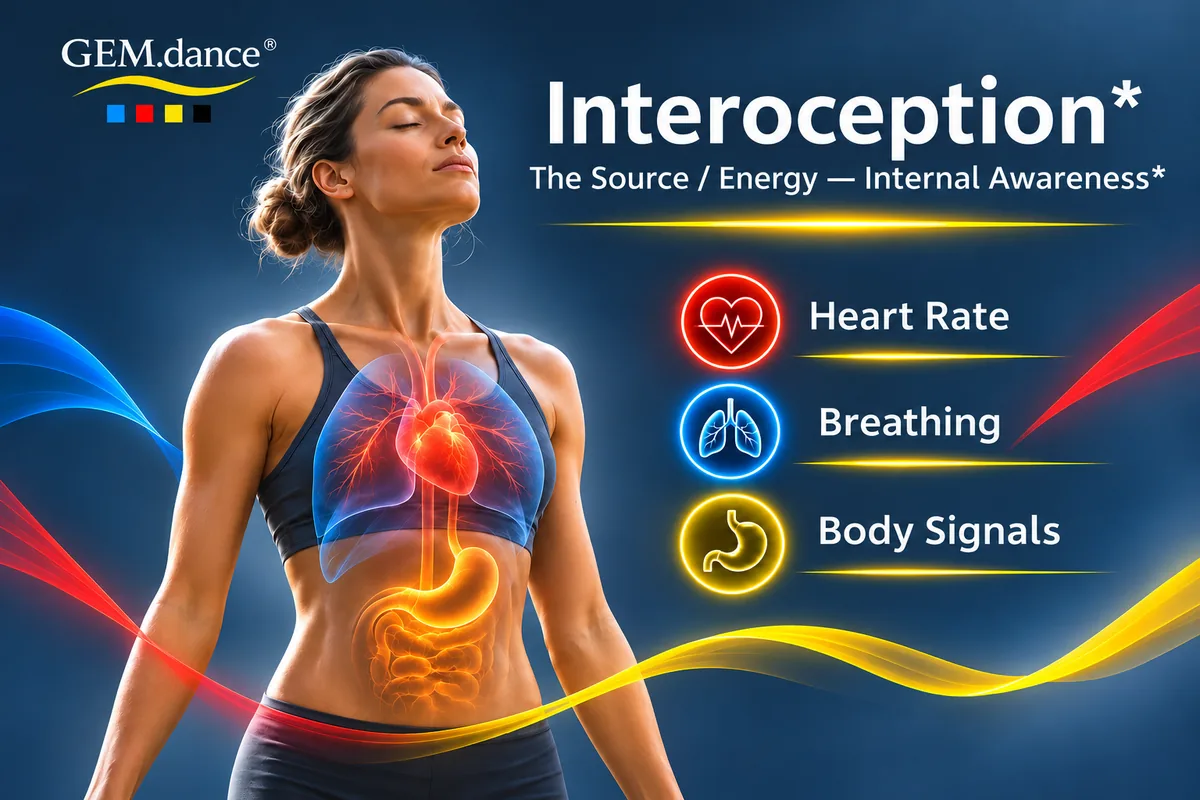
Within the GEM Method, Internal Perception (interoception*) refers to the biological sensory system that detects signals from your own body. This sensory* system continually processes information about bodily processes such as breathing, heartbeat and body temperature, as well as signals associated with internal tension and relaxation.
Body Awareness (proprioception*) provides information about the position and movement of body parts. Internal Perception (interoception*) provides information about the state of the body and the processes taking place within it. This information comes from organs, blood vessels and other internal tissues, among other sources. The communication network (the nervous system*) processes it. Proprioception* and interoception* have distinct functions and work closely together within the body.
The GEM model links these internal bodily processes and signals to the Source*. This GEM term refers to the internal biological processes involved in detecting and experiencing bodily signals, sensing your own energy and emotions, and preparing for a deliberate action.
2. HOW (How the Model Works)
Within the GEM Method, Internal Perception (interoception*) provides a biological starting point for training. Sensory receptors in organs and tissues detect signals from the body and relay them through the communication network (the nervous system*) to the main control panel (the brain*). The brain processes this information about the body’s internal state.
In the GEM Method, you learn to notice these signals without immediately judging them according to personal taste or putting pressure on yourself to perform. In the GEM model, the Source* represents the body’s internal state and the energy you experience. It provides a starting point for building and adjusting movement and creative Expression*.
The model explores the relationship between the body’s internal state and Muscle Dynamics* (4D) through three main bodily (physiological*) variables: breathing, heartbeat and adrenaline. Each has a distinct function and can influence how you prepare for and perform a movement. Breathing and heartbeat are biological processes. Adrenaline is a hormone. The GEM Method considers all three together when exploring bodily activation. Each works differently in the body, and a particular movement response can vary depending on the circumstances.
The Three Main Bodily Variables
1. Breathing (The Regulator)
Breathing helps supply oxygen and is linked to the regulation of muscle tension (Muscle Tone*). During physical exertion, deliberately breathing out can help coordinate effort and muscle tension. Holding your breath can increase pressure in the chest and abdomen and help stabilise the torso. The GEM model explores breathing in relation to Muscle Dynamics* (4D) and the mechanical organisation of the body (3D).
2. Heartbeat (The Rhythm)
Your heartbeat provides information about bodily activity and can change with exertion, tension and emotion. You learn to sense your heartbeat as an internal rhythm and relate it to the intensity you experience and to changes in Muscle Dynamics* (4D). Your heartbeat is one source of information about your current bodily state.
3. Adrenaline (The Impulse)
Adrenaline is a hormone that plays a role in the body’s response to physical or mental stress. This response can influence alertness and readiness for action. Within the GEM Method, you learn to sense signs of this bodily activation through Internal Perception* and relate them to Body Awareness* (proprioception*). This lets you explore how you use this activation to organise and adjust the force of a movement, for example through a sudden (🔴) Muscle Dynamic*.
3. WHEN & WHY (The Biological Starter Motor and How the Elements Relate)
Within the GEM Method, you learn to pay attention to Internal Perception* during moments of rest, during transitions and as you prepare for a deliberate movement in spacetime*. By paying attention to signals from your body, you learn to notice changes in your bodily state.
The GEM Method links Internal Perception* to the Source*. This GEM term refers to what happens inside your body and how you experience energy and emotions. These experiences can influence how you prepare, perform and adjust a movement, and how you express yourself through movement.
The GEM formula P = F + E + D stands for Personality = Form + Expression + Dynamic. In the GEM Method, Internal Perception* is linked to Expression (E) and Dynamic (D).
Research describes links between bodily signals, feelings and consciousness (Damasio, 2010). The GEM Method applies these links in its own way by relating them to the Source*, the GEM formula and Somatic Autonomy*. Damasio’s research addresses the broader relationships between bodily signals, feelings and consciousness.
By deliberately exploring Internal Perception* and observing before making a judgement based on personal taste*, you can discover your current bodily state and notice how it changes. This gives you a starting point for exploring the demands placed on your body and developing Somatic Autonomy*.
4. WHO IS IT FOR?
The Target Group and the Link with Empathy
The GEM Method is intended for everyone, from young beginners to experienced practitioners. It helps dancers, athletes and artists discover their own bodily signals and explore the role these signals play in movement, physical performance and Expression*.
Trained Observers and Bodily Responses
The method is also intended for trained observers, such as coaches, dance partners and therapists, who pay attention to another person’s movements. When observers register another person’s Expression* through External Perception* (exteroception*), their own bodies can respond. They may notice changes in their breathing, heartbeat or muscle tension (Muscle Tone*). Observing and exploring these responses can help them understand the relationship between bodily perception and empathy*.
Recovery and Support
The GEM Method can also provide a framework for people going through recovery, for example in neurorehabilitation*. It also gives therapists a structure for exploring practitioners’ Internal Perception* (interoception*) and bodily experiences.
5. THE AIM
Somatic Autonomy* and 5D Direction*
The aim of the GEM Method is to develop Somatic Autonomy*. This is the ability to sense your own bodily signals and use that information independently to choose and direct movement and Expression*.
You learn to discover, explore and develop your own possibilities. The focus is on individual differences and on how the building blocks of movement work together.
The Mental Lens: C.A.F.*
C.A.F.* stands for Concentration, Attention and Focus. You use these three elements to deliberately direct your perception towards information from your body and surroundings.
By Looking for Fine Detail*, Listening for Fine Detail* and Feeling for Fine Detail*, you learn to discover and explore Micro-nuances*. The information you perceive gives you a starting point for recognising differences, changes and possibilities as you move.
The Source*: Individual Energy Potential
Within the GEM Method, the Source* refers to individual energy potential as it relates to biological processes, physical condition, lifestyle and surroundings.
Factors such as nutrition, sleep, breathing, training, health and mental state vary from person to person and can change throughout life. The conditions under which people can use their energy therefore vary as well.
In the GEM model, the Source* is the starting point for exploring the relationship between energy potential, Potential Force*, Form* and Dynamic*. Your physical condition, perception, knowledge and choices also influence how you use and organise these building blocks and what movement results.
The Building Blocks and the Internal Map*
In the GEM Method, the Internal Map* refers to the information you explore about your own physical condition and movement. By paying attention to bodily signals, you can notice changes and relate them to your movement and Expression*.
In the GEM model, the Source*, Potential Force*, Form* and Dynamic* together form the building blocks of the resulting movement. How they relate to one another and how you use them help shape the form that emerges.
Each body responds in its own way to physical demands, training, recovery and environmental factors. You explore your own responses and possibilities while keeping the outcome open.
Preparation and the Somatic Director*: 5D Direction*
In the GEM Method, the Somatic Director* refers to 5D Direction*, the conscious organisation and direction of information during movement. You bring together your perception of your physical condition, three-dimensional Form* and four-dimensional Muscle Dynamics* in spacetime*.
With C.A.F.*, you direct your perception towards the information available to you. What you perceive, what you know and the choices you make help determine how you use and organise Potential Force*, Form*, Speed*, Tempo* and Dynamic*.
You can also use this process to prepare for a specific performance goal. You learn to recognise your own bodily responses and adapt your preparation to the activity and your individual abilities. You can do this independently or with support from a qualified professional.
Somatic Autonomy* is the ability to work with this information and these possibilities with increasing independence. How the building blocks come together in each person, along with bodily perception, knowledge and the choices made by the Somatic Director*, guides the final form of movement and Expression*.
The aim of the GEM Method is to discover, explore and develop each person’s possibilities for movement and Expression*.