Directing and Supporting the Bodily Circuit
GEM Core
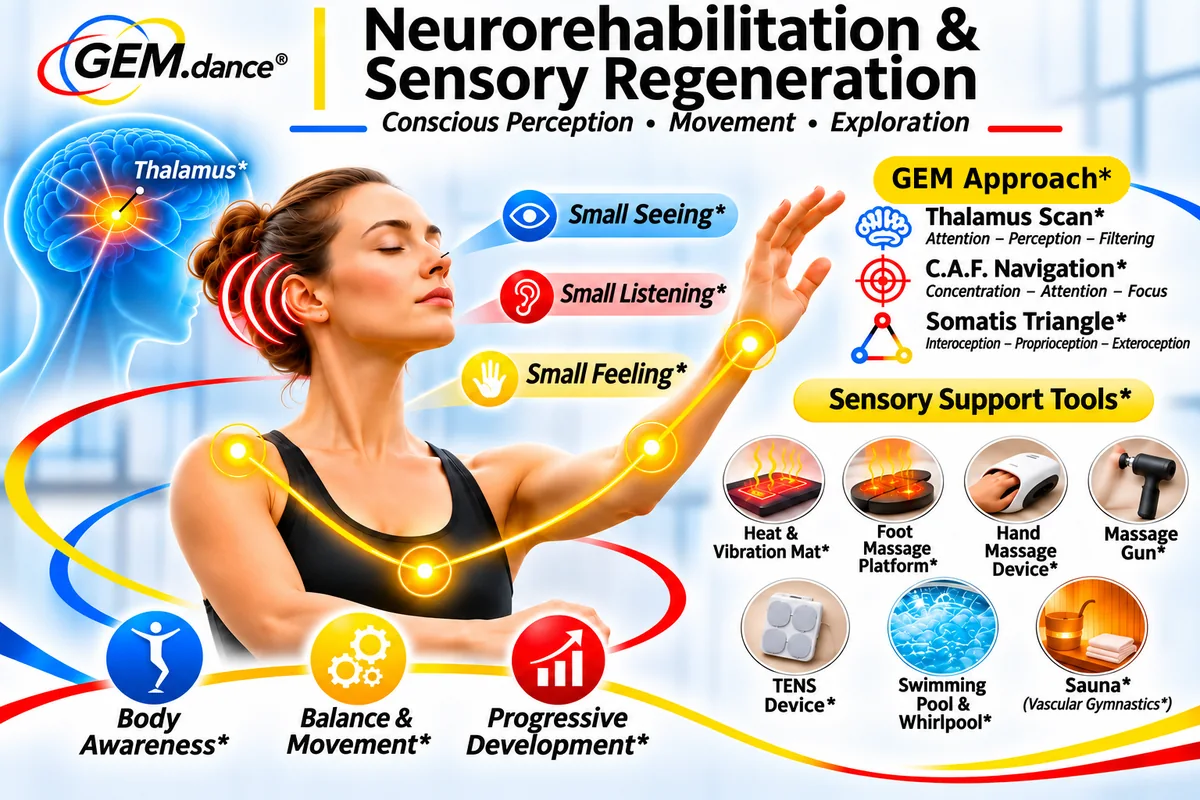
The GEM Method* explores how you perceive your own body and observe your movement and balance. The Thalamus Scan* directs attention to the thalamus*, a part of the brain involved in processing sensory information.
This page describes the Thalamus Scan*, C.A.F. Navigation* and several sensory aids that can be used during recovery. It also explains how to coordinate their use with medical guidance and adapt the exercises and aids to your physical abilities.
1. WHAT — The Thalamus Scan and Sensory Aids*
This part of the GEM Method* focuses on Body Awareness* (proprioception*) during recovery. Through active scanning exercises, you explore how you perceive your own posture, body position and movement. External aids provide additional sensory stimuli.
The Nervous System as a Communication Network*
The nervous system* processes information from the body and its surroundings. The thalamus* is a relay station in the brain that passes many sensory signals to other brain regions (Saalmann & Kastner, 2011). You can compare the nervous system* to a computer system.
- The central nervous system* consists of the brain and spinal cord, where information is processed.
- The nerves carry signals between the central nervous system* and the rest of the body.
In this way, the body receives information about touch, temperature, posture and movement, among other things. The brain processes this information and sends signals to the muscles.
External Aids in the GEM Model
The GEM Method* describes seven aids that provide additional sensory stimuli, such as heat, vibration, pressure, electrical stimulation and water pressure.
Other aids may also fit the model if they relate to one area of the Somatic Triangle*: interoception*, proprioception* or exteroception*. The stimuli provide a reference point for exploring sensory attention and your own movement choices.
2. HOW — Practical Interventions*
The GEM Method* uses three protocols to explore Body Awareness* (proprioception*) and balance.
1. The Thalamus Scan — Exploring the Filtering System*
Sit on a chair and spend one minute noticing the position of a joint while it is still, for example your right wrist.
Reduce visual input with an eye mask or a visual shield (Visual Restriction*), or reduce incoming sound with standard earplugs, custom-made hearing protection, or earbuds or headphones with active noise cancellation (Auditory Restriction*). Then shift your attention to your left wrist.
This is Feeling for Fine Detail*: directing your attention to a specific area of the body.
2. Micro-Asymmetry — Exploring Differences Between the Two Sides of the Body
Slowly perform a simple action using one side of your body (unilateral*), for example your non-dominant side. Use a gradual Muscle Dynamic* (🟡) and follow the movement with your eyes (Looking for Fine Detail*). Explore the differences between left and right and how you control the movement on each side.
3. Static and Dynamic Balance — Balance at Rest and in Motion
Static Balance (Priority 1A)
Stand with both feet on the floor. Use a stable chair or wall for support if needed. Slowly shift your weight towards the balls of your feet and your toes (the 9th and 10th Major Movers*). Notice the pressure beneath your feet and pay attention to your breathing (Internal Perception*). During rehabilitation, check with your treating clinician whether it is appropriate to try this exercise briefly with your eyes closed (Visual Restriction*).
Dynamic Balance (Priority 1B)
Use C.A.F. Navigation* to direct your attention as you walk through the space. Move with a gradual Muscle Dynamic* and explore your Floor Pathways*, the routes you take across the floor, like footprints in sand. Pause briefly as you walk to notice your weight distribution and posture.
3. WHEN & WHY — Timeframes and an Overview of the Equipment
In the GEM model, the aids are used with the C.A.F. Formula* and either Visual Deactivation* (closing your eyes) or Auditory Deactivation* (reducing incoming sound). The model proposes two timeframes for exploring possible responses to the aids.
- Short term (immediately after use). The GEM model proposes exploring whether Vascular Tone* decreases and whether areas of sustained muscle tension relax. The model uses the image of a temporarily clearer flow of information to the thalamus*. Within the GEM approach, this is the point at which the practitioner can explore Micro-Training* through Weight Actions* and Muscle Dynamics*.
- Long term (after 3 to 12 months of regular use). The GEM model proposes investigating whether regular use is associated with more stable neural connections serving the areas involved (neuroplasticity*) and with longer-term regulation of elevated baseline tension in the body.
- Regular use. The GEM model emphasises consistency. Its proposed routine is a short session of 10 to 15 minutes, once or twice a day, at a regular rest time. During recovery, the choice of aid, duration and frequency should follow the instructions for the specific device and the guidance of the treating clinician.
The Seven Aids* — General Use in the GEM Method
The seven aids provide different types of physical stimuli, such as heat, vibration, pressure, compression and water pressure. They can be used on different parts of the body.
During and after use, you can pay attention to the bodily signals you notice. With C.A.F. Navigation* (Concentration, Attention and Focus), you can explore how these signals relate to Weight Actions* (3D) and Muscle Dynamics* (4D).
You can use this approach in different body positions. Even when an aid supports, surrounds or holds a body part in place, you can still pay attention to the bodily signals you notice and the movements available to you.
Within the GEM Method*, the aids provide an additional way to explore Body Awareness* and Movement Awareness*.
1. Heat and Vibration Mat* (Heat and Vibration Therapy)
A heat and vibration mat combines localised heat with mechanical vibration. Within the GEM Method*, the mat can be used to notice bodily signals and explore Body Awareness* (proprioception*).
What can it do?
Studies in humans show that heat and vibration can affect skin blood flow, skin temperature, pain perception and range of movement, among other things. Researchers have also studied heat and vibration in combination. The effects vary from person to person and depend on the treatment used.
Within the GEM Method*, the mat provides heat and vibration stimuli that you can use to explore your own body awareness.
2. Foot Massage Platform* (Infrared Heat and Vibration Therapy)
A foot massage platform applies infrared heat and mechanical vibration to the soles of the feet. The skin on the soles contains touch and pressure receptors (mechanoreceptors) that relay information about touch, pressure and vibration to the nervous system.
What does the research show?
Studies in humans show that heat can affect how sensitive the soles of the feet are to vibration. Researchers have also found changes in balance measurements with certain forms of foot stimulation and vibration training. The results vary with the type of treatment and the group studied.
3. Hand Massage Device* (Infrared Heat and Compression Therapy)
A hand massage device combines heat with rhythmic air pressure to compress the hands and fingers.
What does the research show?
Studies in humans show that intermittent air compression can affect local blood flow. Touch and pressure receptors (mechanoreceptors) detect mechanical pressure, and the nervous system processes the signals. Researchers have also investigated changes in sensory perception, including the sense of touch and movement. The results vary with the treatment and the group studied.
4. Massage Gun* (Percussion Therapy)
A massage gun uses an attachment to deliver rapid, repeated pulses of mechanical pressure to the muscles and surrounding tissues.
What does the research show?
Studies in humans show that percussion therapy can lead to short-term changes in range of movement, flexibility and perceived muscle soreness. The results vary with the treatment and the group studied. Its precise physiological mechanisms remain under investigation. Evidence is still needed to establish whether it generally changes the structure of muscle and connective tissue, regulates Vascular Tone* or releases persistent muscle tension.
5. TENS Device* (Mild Electrical Stimulation)
A TENS device delivers mild electrical pulses through electrodes placed on the skin. These pulses stimulate sensory nerve fibres, which relay signals to the nervous system.
What does the research show?
Studies in humans show that TENS can affect the way pain signals are processed and may provide temporary pain relief in some applications. The effects depend on the settings, the way the treatment is given and the group studied. Researchers have also studied how TENS affects the processing of sensory information. Its effect on Body Awareness* (proprioception*) remains uncertain.
6. Swim Spa and Jacuzzi* (Hydrotherapy*)
A swim spa or jacuzzi provides a place to rest or move in warm water. Three properties of water play a role.
- Water pressure (hydrostatic pressure*). Water presses against your body from all sides. This pressure affects how blood is distributed in the body and provides the nervous system with information about pressure on the skin.
- Upward force (buoyancy). The water supports part of your body weight, reducing the load on your joints and muscles.
- Heat. Warm water can affect blood flow in the skin and may temporarily reduce pain and muscle tension.
What does the research show?
Studies in humans show that immersion in water affects how blood is distributed in the body. Moving in water can also reduce the load on joints and affect balance and how movements are performed. The effects vary with the type of activity and the group studied.
7. Sauna Session* (Vascular Gymnastics*)
A sauna session involves spending time in a heated room, sometimes alternating with periods of cooling. Heat and cold produce different responses in the blood vessels. Heat causes blood vessels in the skin to widen, while cold can cause them to narrow. Within the GEM Method*, this alternation is called Vascular Gymnastics*. You use it to explore how your body responds to changes in temperature.
What does the research show?
Finnish population studies have found a link between regular sauna use and a lower risk of certain cardiovascular diseases, stroke and dementia. Whether sauna use itself prevents these conditions remains an open question. Researchers have also studied changes in blood vessel function and arterial stiffness. The precise effects vary from person to person and depend on how the sauna is used.
4. WHO IS IT FOR? (The Target Group)
The GEM Method* is accessible to people of all ages, from beginners to experienced practitioners, including athletes, dancers and artists. The platform offers ways to explore and further develop your Body Awareness* and movement possibilities.
People who experience migraine or sensory overload, or who are recovering from a medical procedure involving the brain, can also learn about the method. If you have health concerns or are recovering from a medical procedure, discuss the exercises and use of aids with your GP or treating specialist.
This section also provides information for coaches, physiotherapists and partners who want to support people with movement activities and recovery.
5. THE AIM (Safety and Capacity for Physical Load)
The aim is to develop bodily independence* through the Somatic Director* (5D — Conscious Awareness). You develop your ability to notice your physical condition, bodily signals and limits, and adjust your movement and physical exertion accordingly.
Two guidelines are central to the GEM Method*.
1. GEM Guideline on Physical Load (Quality over Quantity)
Micro-Training* and sensory aids offer ways to develop Body Awareness* and Movement Awareness*. Adapt the duration, frequency and intensity to the person and their current physical condition (baseline*). The starting point is to pay conscious attention to bodily signals and stay within your physical capabilities.
2. Medical Coordination & Safety
If you have a medical condition, are receiving treatment or are recovering, discuss the exercises and use of aids with your GP or treating specialist. This helps tailor the use of the GEM Method* to your medical circumstances and to the level of physical load you can currently tolerate.
4. WHEN & WHY (Blind Choreography*)
During studio training, you activate C.A.F. Navigation* when performing Blind Choreography*.
Visual Deactivation* (closing your eyes) or Auditory Deactivation* (blocking your ears) reduces external sensory input as much as possible. This includes visual reference points, external rhythms and sounds in the surroundings. Your perception then shifts towards information available through your own body, such as bodily sensations and contact with the floor.
As you navigate spacetime*, you use C.A.F. Navigation* to direct your Concentration, Attention and Focus while moving. This framework helps you discover and explore, step by step, how the Context*, the sensory information still available to you and your movement choices relate to one another.
5. WHO IS IT FOR? (The Target Group)
The GEM Method* is intended for anyone who wants to explore how their body senses and moves. People of different ages and with varying levels of movement experience can use the method.
This includes athletes, dancers and artists who want to explore how they move and how they can develop their technique. They can draw on their own bodily perception or use a mirror or video recordings. Bodily perception provides information about what they feel in their own body. A mirror and video recordings provide visual information about their movement.
Coaches, trainers and therapists can also use C.A.F. Navigation* to observe movements and explore their characteristics. They can distinguish between what they see or hear and what they infer from it.
People recovering from an illness or medical procedure can use the method to notice bodily sensations and changes as they move. The exercises should match what each person can do and can be combined with guidance from a healthcare professional when needed.
6. THE AIM (5D Direction*)
Within the GEM Method*, the Somatic Director* (5D — Conscious Awareness) refers to consciously perceiving and directing your own movement.
The aim is to perform a movement with attention to technique while noticing and consciously organising it as it happens. This brings together Body Awareness*, movement Form and Dynamic.
The GEM Method* links this process to Embodiment*, the experience of sensing and performing movement as part of your own body and actions.
You explore how to direct your own movement using Body Awareness*, C.A.F. Navigation* and information from your surroundings. You can do this with or without visual aids such as a mirror or video recording.
Bodily independence* is central to the GEM model. It means being able to perceive, organise and adjust your own movement as it happens.