

Exteroception* (The Context / Direction — External Perception*)
Perceiving information from your surroundings
GEM Core
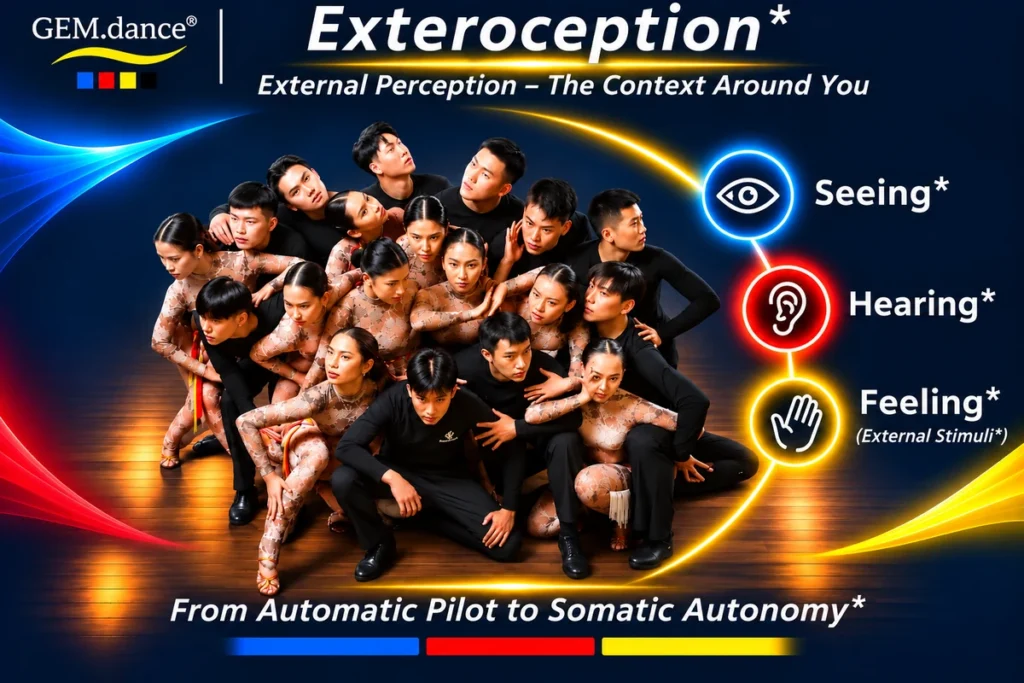
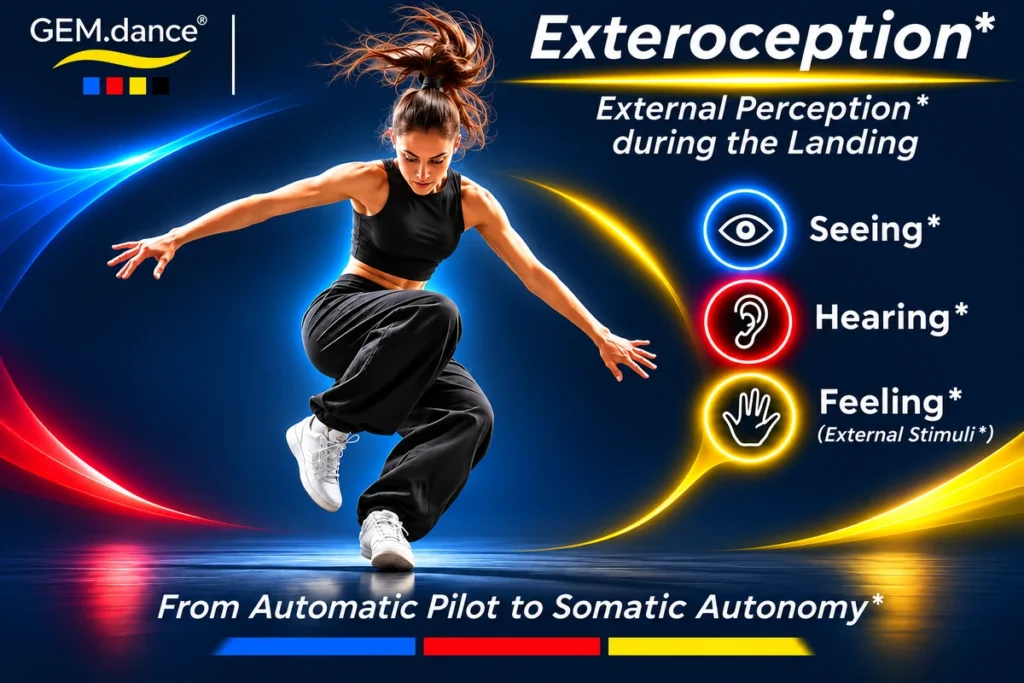
Exteroception* (External Perception*) is the ability to detect stimuli from your surroundings through your senses, including sight, hearing and touch. Examples of this information include the space available, sounds and music, visual information, and the presence and movements of partners.
In the theoretical GEM model, the Somatic Director* (5D) uses this information to organise movement. You can use it to adapt the direction, timing and execution of a movement to your surroundings and your chosen movement goal.
1. WHAT (The System)
External Perception* (exteroception*) means sensing stimuli from your surroundings through sight, hearing, smell, taste and touch.
In the theoretical GEM model, External Perception* provides information about your surroundings. This information forms part of the Context* in which a movement takes place. The GEM Method organises it into three elements specific to the model.
- Spatial Direction (Space). Information about your surroundings, such as the dance studio, other people and objects, and about the position of your body in relation to them.
- Timing (Time). Information about sounds and music, including rhythm and Tempo*.
- Relationship. Information about other people, their movements and physical contact. This could include the pressure of a dance partner’s hand or contact with an object.
Together, these three elements provide a framework for describing information from the surroundings within the GEM Method. The biological classification of the senses remains separate from this GEM framework.
Visual anchor 🟡 Yellow represents direction and active change in space within the GEM Method.
2. HOW (Processing Space and the Filtering System)
Throughout the day, you receive a large amount of information from your surroundings through External Perception*. The nervous system* selects and processes this information through automatic filtering processes. These processes help determine which stimuli take priority and are relayed at a given moment (Saalmann & Kastner, 2011). The information that reaches conscious awareness varies from person to person and from situation to situation. When your attention is strongly directed towards stimuli in your surroundings, you may be less aware of signals from other sensory systems, such as Body Awareness* (proprioception*) and Internal Perception* (interoception*).
In the GEM Method, you use the MT Switch* together with the mental lens of the C.A.F. Formula* (Concentration, Attention and Focus) to direct your attention deliberately towards relevant signals. By deliberately directing your sensory perception and attention, you can select and connect information from your own body and your surroundings. In the theoretical GEM model, the Somatic Director* (5D) provides a structure for consciously organising and using this information to direct movement.
3. WHEN & WHY (The Closed Circuit in the GEM Model)
In the theoretical GEM model, the Somatic Triangle* connects three forms of perception: External Perception*, Internal Perception* and Body Awareness*. The GEM Method describes their relationship as a closed circuit. The model represents this continuous conceptual route as follows:
[External Perception* / Context] ➔ [Internal Perception* / Energy] ➔ [Body Awareness* / Form and Potential Force*] ➔ [Feedback to External Perception* / Context]
The GEM Method uses this route as a theoretical framework for exploring how information from your surroundings can relate to your internal bodily state and the way you organise movement. The sequence describes one specific route within the GEM model. In everyday life and during movement, these sensory systems can be active at the same time and relay information to the nervous system* in varying sequences.
In training, this route helps you discover and explore the relationships between Context*, available energy and movement choices step by step. Feedback helps you see how a movement you have performed, and what you perceive as a result, can influence your next movement choice.
4. WHO IS IT FOR? (The Target Group)
This platform is designed for individual athletes, dancers and artists who want to perceive and regulate their physical Expression* more consciously, develop further or rediscover their movement possibilities. In dance, the model helps you explore the 10 Major Movers* in relation to Air Pathways*, Floor Pathways* and the timing of movement in space.
The method can also be used by people who want to explore and practise Body Awareness* and balance. Its use for specific medical conditions, during recovery or in neurorehabilitation* depends on individual circumstances and any professional guidance. The exercises are intended to support general body awareness. Medical treatment remains a separate part of care.
Trained observers, such as coaches and therapists, can also use GEM terminology and observation criteria to describe and analyse movement patterns systematically.
5. THE AIM (5D Direction)
In the theoretical GEM model, the Somatic Director* (5D / conscious awareness) describes the relationship between Internal Perception*, thoughts and perception of the outside world. By deliberately directing your sensory attention to Micro-nuances* through Looking for Fine Detail*, Listening for Fine Detail* and Feeling for Fine Detail*, you may become aware of signals that previously escaped your attention.
You then explore these signals and learn to distinguish them more clearly from other stimuli. In the GEM Method, this approach helps you explore and consciously develop the quality of your movement. The thalamus*, which helps relay and regulate sensory information, is part of the biological context in which these perceptual processes take place.