C.A.F. Navigation* — Looking, Listening and Feeling for Fine Detail
Consciously perceiving and directing the bodily (somatic) circuit*
GEM Core
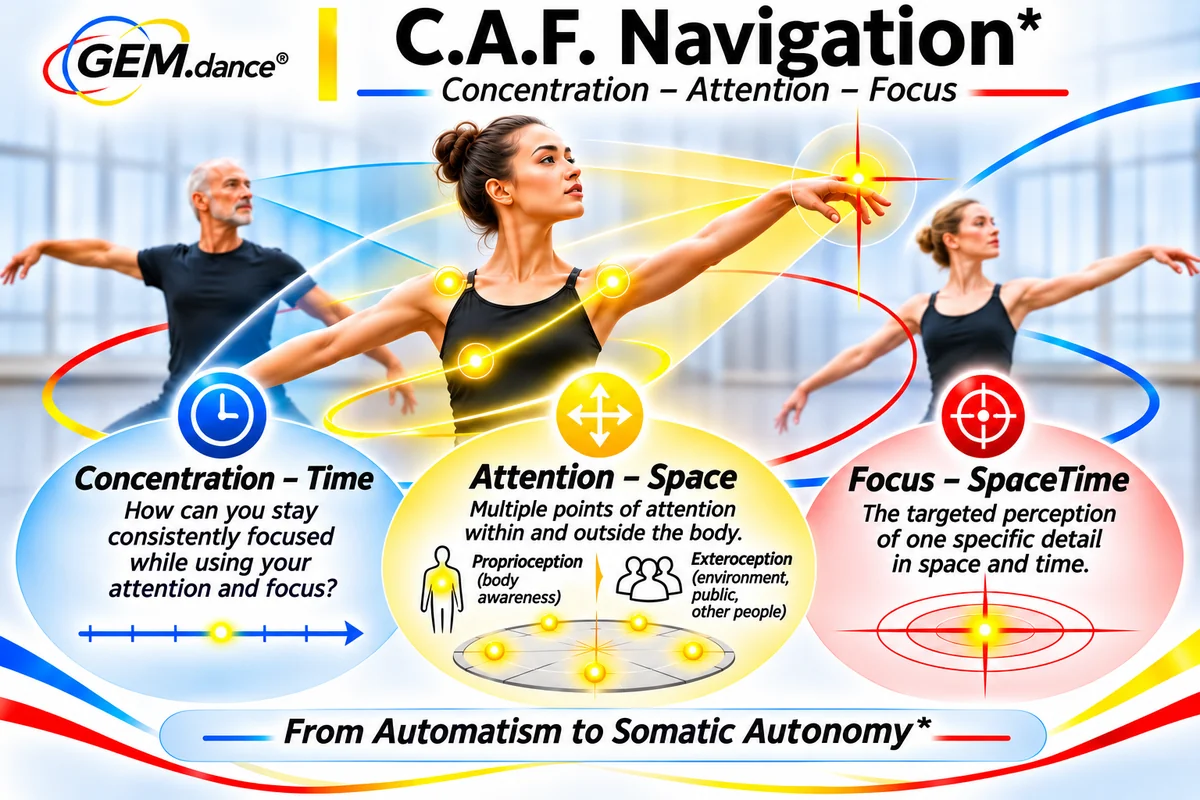
Within the GEM Method*, C.A.F. Navigation* is the mental lens you use to direct your perception consciously. C.A.F. stands for Concentration, Attention and Focus. In the theoretical GEM model, these three concepts are distinct. They are linked to time, space and spacetime*, respectively.
1. WHAT — C.A.F. Navigation as a Mental Magnifying Glass
Within the GEM Method*, C.A.F. Navigation* distinguishes three functions that help practitioners explore their own perception. In the theoretical GEM model, Concentration*, Attention* and Focus* are linked to time, space and spacetime*, respectively.
Concentration* (Time — Sustaining Mental Effort)
In the GEM model, Concentration* means sustaining mental effort while carrying out a task or action, or pursuing a specific observation goal. How long this effort can be sustained varies with the person, their experience, the surroundings and the nature of the task.
Attention* (Space — Directing and Shifting Attention)
In the GEM model, Attention* means directing and shifting attention. Practitioners explore what they are attending to and how their attention can shift between information from their own body and information from their surroundings.
Focus* (Spacetime* — Examining a Specific Detail)
In the GEM model, Focus* means deliberately examining a specific detail in its spatial and temporal context. This could be a joint angle, the start of a movement or a change in the movement at a particular moment.
The three functions work together, and each has a distinct meaning within C.A.F. Navigation*. Together, they provide a framework for exploring how long mental effort is sustained, where attention is directed and which detail is examined more closely.
These links serve as a conceptual tool within the GEM Method*. The terms also have established definitions in biology and psychology.
2. HOW — Directing Perception
Within the GEM Method*, practitioners explore how they perceive, select and examine information. Looking for Fine Detail, Listening for Fine Detail and Feeling for Fine Detail are practical ways to discover micro-nuances* in their surroundings, their own body and movement.
How these practices are used depends on the observer’s role. External observers examine information available from outside. Internal observers explore their own bodily experience and the information they sense from within their body.
2.1 The External Observer (Observing from Outside)
External observers direct their perception towards another person, a movement or the surroundings. The aim is to examine observable features as precisely as possible and distinguish direct observations from assumptions, interpretations and judgements.
- Looking for Fine Detail* — Examine visible details such as posture, movement direction, joint positions and changes in movement form.
- Listening for Fine Detail* — Examine audible details such as rhythm, sound, accents, moments of silence and timing.
- Feeling for Fine Detail* — Examine information available through touch or physical contact, such as pressure, resistance or changes in contact.
What external observers can establish depends on the information available. They can describe the movement they see. Understanding what the other person feels in their body requires information beyond the visible movement.
2.2 The Internal Observer (Observing from Within)
Internal observers direct their perception towards their own bodily experience while holding a posture, performing an action or moving. Practitioners explore what they sense in their body and how that experience changes as they move.
- Looking for Fine Detail* — Examine details of your own posture or movement that you can see.
- Listening for Fine Detail* — Listen to sounds made by your own movement or audible in your surroundings.
- Feeling for Fine Detail* — Explore bodily sensations such as pressure, muscle tension, balance, joint position and movement.
The internal observer’s own experience is central. It is important to distinguish what you actually feel, what you can see or hear and what you infer from those observations.
2.3 How the Functions Work Together — Space and Time
The GEM Method* uses Concentration*, Attention* and Focus* as three related functions. The GEM model links them to time, space and spacetime*, respectively.
- Concentration* — Time — Sustain mental effort during a task.
- Attention* — Space — Direct and shift attention.
- Focus* — Spacetime* — Examine a specific movement detail at a particular moment.
The three functions can work together during movement. For example, a practitioner can stay engaged with a movement task, shift attention to another part of the body and then examine a specific detail of the movement.
C.A.F. Navigation* offers a way to explore different aspects of perception and learn to recognise your own movement choices more clearly.
2.4 C.A.F. Navigation* in Practice
Within the theoretical GEM model, C.A.F. Navigation* offers three questions to guide the exploration of perception.
- Concentration* (For how long?) — Sustain mental effort while pursuing the observation goal.
- Attention* (Towards what?) — Direct and shift attention towards information from the body or the surroundings.
- Focus* (Which detail?) — Select a specific feature and examine it more closely.
These functions can be used in both external and internal observation. They can complement one another and be used in different orders.
2.5 From Perception to Discovery
By deliberately varying what they attend to, practitioners can discover similarities and differences between what they feel in their body, the movement they can see and the information from their surroundings.
Within the GEM Method*, the aim is to refine perception, recognise micro-nuances* and explore new ways of moving. This helps practitioners become more aware of their own movement choices and develop them further.
3. WHAT FOR? — The Purpose and Meaning of C.A.F. Navigation*
Within the GEM Method*, C.A.F. Navigation* helps practitioners explore
more consciously how they direct their perception and which details
they notice as they move.
The theoretical GEM model distinguishes three related functions.
- Concentration* — Time — How long do you sustain
mental effort? - Attention* — Space — Where do you direct your attention?
- Focus* — Spacetime* — Which specific details do you
examine more closely in a particular place and at a particular time?
This framework helps practitioners discover micro-nuances* in their
surroundings, in their own body and in their movement. The three
functions can complement and influence one another. For example, an
external observer can draw a practitioner’s attention to a particular
aspect of a movement. The practitioner can then examine that aspect
more closely for themselves.
The aim of C.A.F. Navigation* is to direct perception more consciously,
discover differences and explore possibilities for making your own
movement choices and developing bodily independence*.
4. WHEN & WHY (Blind Choreography*)
During studio training, practitioners activate C.A.F. Navigation* when performing Blind Choreography*.
Practitioners use Visual Deactivation* (closing their eyes) or Auditory Deactivation* (using hearing protection) to limit external sensory input as much as possible. This includes visual reference points, external rhythms and sounds in the surroundings. Perception then shifts towards information available through their own body, such as bodily sensations and contact with the floor.
As practitioners navigate spacetime*, they use C.A.F. Navigation* to apply Concentration, Attention and Focus deliberately while moving. This framework helps them discover and explore, step by step, how the Context*, the sensory information still available to them and their own movement choices relate to one another.
5. WHO IS IT FOR? (The Target Group)
The GEM Method* is intended for anyone who wants to explore how their body perceives and moves. People of different ages and with different levels of movement experience can use the method.
This includes athletes, dancers and artists who want to explore how they move and how they can develop their technique. They can draw on their own bodily perception or use a mirror or video recordings. Bodily perception tells them what they feel in their own body. A mirror and video recordings provide visual information about their movement.
Coaches, trainers and therapists can also use C.A.F. Navigation* to observe movements and examine their features. They can distinguish between what they see or hear and what they infer from it.
People recovering from an illness or medical procedure can use the method to notice bodily sensations and changes as they move. The exercises should match what each person can do. They can be combined with guidance from a healthcare professional when needed.
6. THE AIM (5D Direction*)
Within the GEM Method*, the Somatic Director* (5D — conscious awareness) refers to consciously perceiving and directing your own movement.
The aim is to perform a movement with attention to technique while perceiving and consciously organising it as it happens. This brings together Body Awareness*, movement Form and Dynamic.
The GEM Method* links this process to Embodiment*: experiencing and performing movement as part of your own bodily experience and actions.
You explore how to direct your own movement using Body Awareness*, C.A.F. Navigation* and information from your surroundings. You can do this with or without visual aids, such as a mirror or video recording.
Bodily independence* is central to the GEM model. It means being able to perceive, organise and adjust your own movement as it happens.