The GEM Dictionary (A–Z)
The concepts and terminology of the GEM Method
💡 Why does the GEM Method have a dictionary?
The GEM Method uses existing terms and terms developed within the method to explore and describe human movement, perception, sound, learning, behaviour and the process of becoming aware.
Since 2002, Ton Greten has drawn on philosophical thinking, observation and practical experience to explore the meaning of concepts such as Form, Expression, Dynamic, energy, force, time and space.
This research takes place as he develops and applies the GEM Method. It draws in part on his work as a choreographer, dancer, trainer, teacher, coach and researcher.
The GEM Dictionary (A–L)
A–C
Acoustic Absorption* (GEM neologism)
The audible result of a landing* cushioned by muscular action, in which an external observer hears a soft or springy sound in spacetime*.Air Pathways* (GEM neologism)
The three-dimensional routes (direct and geometric, or indirect and organic) that limbs or body parts follow as they move freely through space without contact with the floor or a supporting surface.Amygdala* / The Fear Centre
Two small, almond-shaped nuclei located deep within the main control panel (the brain*). This centre responds directly to exciting or threatening sensory (exteroceptive*) stimuli, such as action or horror films, and immediately puts the body into a state of heightened alertness. The practitioner can calm this centre by closing their eyes (visual deactivation*) and directing their Attention to the internal points of contact.Auditory Deactivation* (GEM neologism)
Deliberately reducing or muffling external sound stimuli by using hearing protection. This reduces the unpredictable noise reaching the filtering station (the thalamus*), such as environmental noise or snoring, to support the inner dialogue and the deep phases of tissue recovery.Autonomy / Physiological Autonomy* (GEM neologism)
The self-directed regulation of movement through internal body awareness*, independently of an external visual frame of reference.Blended Forms* (GEM neologism)
The physical variations and movement characteristics that arise in spacetime* when the Somatic Director* (5D) links Muscle Dynamics* (4D) with Weight Actions* (3D).Blending* (GEM neologism)
Combining movement and adjusting its components in spacetime* to make a transition from position A to position B.Bounce* (GEM neologism)
An elastic, springy sequence of landing (impact*) and upward force, in which the joints bend and extend to absorb and regulate the impact.Brain* / The Main Control Panel
The central organ in the upper part of the head that receives all signals from the neural pathways (the nervous system*). This control panel directs the muscles, processes incoming sensory information, regulates thinking and houses active awareness (the Somatic Director* / 5D).-
C.A.F. Navigation* (2D) / C.A.F. Formula* (GEM neologism)
C.A.F. stands for Concentration, Attention and Focus. Within the GEM Method, C.A.F. Navigation* is the second Somadimension* (2D). It is the mental lens practitioners use to direct their perception consciously.- Concentration* (Time) — How long do you sustain mental effort during a task or observation?
- Attention* (Space) — Where do you direct your attention, and how do you shift it between your body and your surroundings?
- Focus* (Spacetime*) — Which specific detail do you examine at a particular place and time?
The Somatic Triangle* (1D) describes three sources of perceptual information within the GEM model. C.A.F. Navigation* (2D) helps you decide what to attend to and what to examine more closely. For example, while opening a door, you can sustain your mental effort throughout the action, shift your attention from your feet to your hand and focus on the pressure against your fingers as the handle begins to turn. The three functions can work together and can be used in different orders.
-
Change Point* (GEM neologism)
A Change Point* is a point in Somaflow* at which the Pathway of one or more of the 10 Major Movers* changes or is adjusted. The movement can continue through that change. The GEM Method distinguishes two Pathways, Geometric* (direct) and Organic* (indirect). They can be performed separately, simultaneously or in varying combinations. The Weight Actions* (3D) of bending, extending and rotating determine the possibilities for movement in space. Muscle Dynamics Blending* (4D) determines how these movements develop over time.Single Change Point* — One Major Mover* changes or adjusts its Pathway.
Composite Change Point* — Several Major Movers* change or adjust their Pathways at the same time or at different moments.The Somatic Director (5D)* can consciously perceive, direct and combine these changes.
Circadian Rhythm* / The Biological Clock
The body’s internal 24-hour rhythm, which regulates basic functions in response to light and darkness. Its purpose is to maintain energy balance. This rhythm determines when the communication network (the nervous system*) shifts from active alertness during the day to the deep phases of recovery at night.Cortisol* / The Stress Hormone
A chemical substance (a hormone) produced by the body in response to stress or overstimulation. This hormone temporarily increases tension in the blood vessels (vascular tone*) and muscles (muscle tone*). When the hormone remains present for a prolonged period, it inhibits physical recovery.
D–G
Deliberate Training*
A training method in which the practitioner uses focused mental attention to analyse and directly regulate specific physical details.Dynamic (4D)
The fourth dimension of the Movement Matrix*, which describes the active state of the body and how it changes over time. It is the general term for how the 10 Major Movers* change their position or tension in spacetime*.Embodiment*
A state in which the body and conscious direction work in harmony, allowing the practitioner to fully embody the movement as it happens.Emotion*
Within the GEM Method, emotion is the Form through which feeling is expressed. This expression can be seen or heard in body language, facial expressions, gestures, posture, movement and the use of the voice. Observable expression can help an observer recognise a person’s inner experience. What the person feels remains uncertain to the observer.Event* (Concept in physics, via Minkowski)
A fixed point in spacetime*. It shows the position of the bones (3D) at one specific moment of measurement in time (4D).Events* (Concept in physics, via Minkowski)
A sequence of individual measurement points (events*) in spacetime*. Several such moments in succession form a continuous flow through which the nervous system registers the broader context, direction and timing of the movement (4D).Expression*
The animation and communication of emotion within the GEM Method, through which internal energy (the Source*) and the inner dialogue become visible and perceptible to others through Form*.-
Exteroception / External Perception* (GEM neologism)
The sensory system through which the practitioner registers their surroundings using senses such as sight and hearing. Within the GEM model, Exteroception is one of the three forms of perception in the Somatic Triangle* (1D). It allows practitioners to coordinate the 10 Major Movers* with the Air Pathways*, the Floor Pathways* and the timing of movement in space.Visual anchor — 🟡 Yellow represents direction and active change in space.
Fascia* / Elastic Connective Tissue
A continuous, elastic suit beneath the skin that surrounds all the muscles, bones and joints. This tissue consists largely of water and allows the different parts to glide smoothly past one another during movement.Feeling*
Within the GEM Method, feeling forms the Source from which emotion is expressed. Feeling refers to a person’s inner experience and is linked to their physical and mental state and personal experiences.Floor Pathways* (GEM neologism)
The paths and routes (direct and geometric, or indirect and organic) that body parts follow as they move while maintaining direct, sliding or rolling contact with the supporting surface.Form* / 3D (GEM neologism)
The physical architecture of the skeleton in space. It is determined by the three mechanical Weight Actions* (bending, extending and rotating) of the 10 Major Movers*.GEM Method Formula*
P = F + E + D (Personality = Form + Expression + Dynamic).
I–L
Impact* (GEM neologism)
The act of stabilising or absorbing a movement through a sudden (🔴) transition to sustained (🔵) muscle tension.Impulse* (GEM neologism)
A sudden (🔴) input of mechanical energy from the muscles, often from the core, that sets a limb or joint in motion.Internal Map* (GEM neologism)
The practitioner’s sense of their own body at a given moment, including where the body parts are, how they are moving and what they can sense within the body. In the GEM Method, practitioners use this information to explore body awareness.-
Interoception / Internal Perception*
The established scientific term for sensing signals and processes within your own body, such as breathing, heartbeat and sensations associated with rest or tension. Within the GEM model, Interoception is one of the three forms of perception in the Somatic Triangle* (1D). Awareness of your current physiological state provides a continuous biological starting point during movement.Visual anchor — 🔴 In the GEM Method, red symbolises the warm energy of the Source*.
Joint Chains* (GEM neologism)
The way successive joints (such as the shoulder, elbow and wrist, or the ankle, knee and hip) work together as links and transfer mechanical forces between them. Force and speed pass from one joint to the next to create a larger movement form.Jumping*
The sudden (🔴) extension of joints, such as those in the feet and legs, to move the body off the supporting surface. This is followed by a moment of Release* and a gradual (🟡) Landing*.Landing* (GEM neologism)
The physiological and mechanical moment when the mass of a body part makes contact with a supporting surface (the floor, a partner or the group) after travelling along an Air Pathway*. The energy of movement (kinetic* energy) is converted into mechanical Impact* through the Joint Chains*.Lifestyle Transition* / Lifestyle Change (GEM neologism)
The gradual, long-term reshaping of daily habits relating to sleep patterns, diet, alcohol intake and screen use, such as using social media or watching television in bed. The aim is to provide ongoing support for the nervous system*, free from short-term restrictions or performance pressure.Looking / Listening / Feeling for Fine Detail* (GEM neologism)
Deliberately tuning the senses to subtle details in and around the body. Practitioners use the MT Switch* and C.A.F. Navigation* (2D) to direct their attention towards information from one or more of the three forms of perception in the Somatic Triangle* (1D). In this way, they learn to perceive and direct their current Weight Actions* (3D) and Muscle Dynamics* (4D) in spacetime*.
M–N
Mechanical Impact* (GEM neologism)
The physiological force or fixation that occurs in the tissues and joints at the exact moment a movement stops through a Landing*, or when a sudden* (🔴) Muscle Dynamic changes to sustained* (🔵) tension.Melatonin* / The Sleep Hormone
A substance produced naturally by the brain when sensory (exteroceptive*) light stimuli decrease. This hormone regulates the recovery rhythm and initiates the deep phases of tissue recovery.Micro-nuances* (GEM neologism)
Very small details or subtle changes in the body or surroundings that practitioners can discover through focused looking*, listening* and feeling*.Micro-Training / 16-Hour Mental Studio* (GEM neologism)
Brief moments of deliberate focus on bodily processes during everyday activities. These moments help practitioners integrate the direction provided by the Somatic Director* (5D) outside formal studio hours.Movement Matrix* / The Movement Alphabet (GEM neologism)
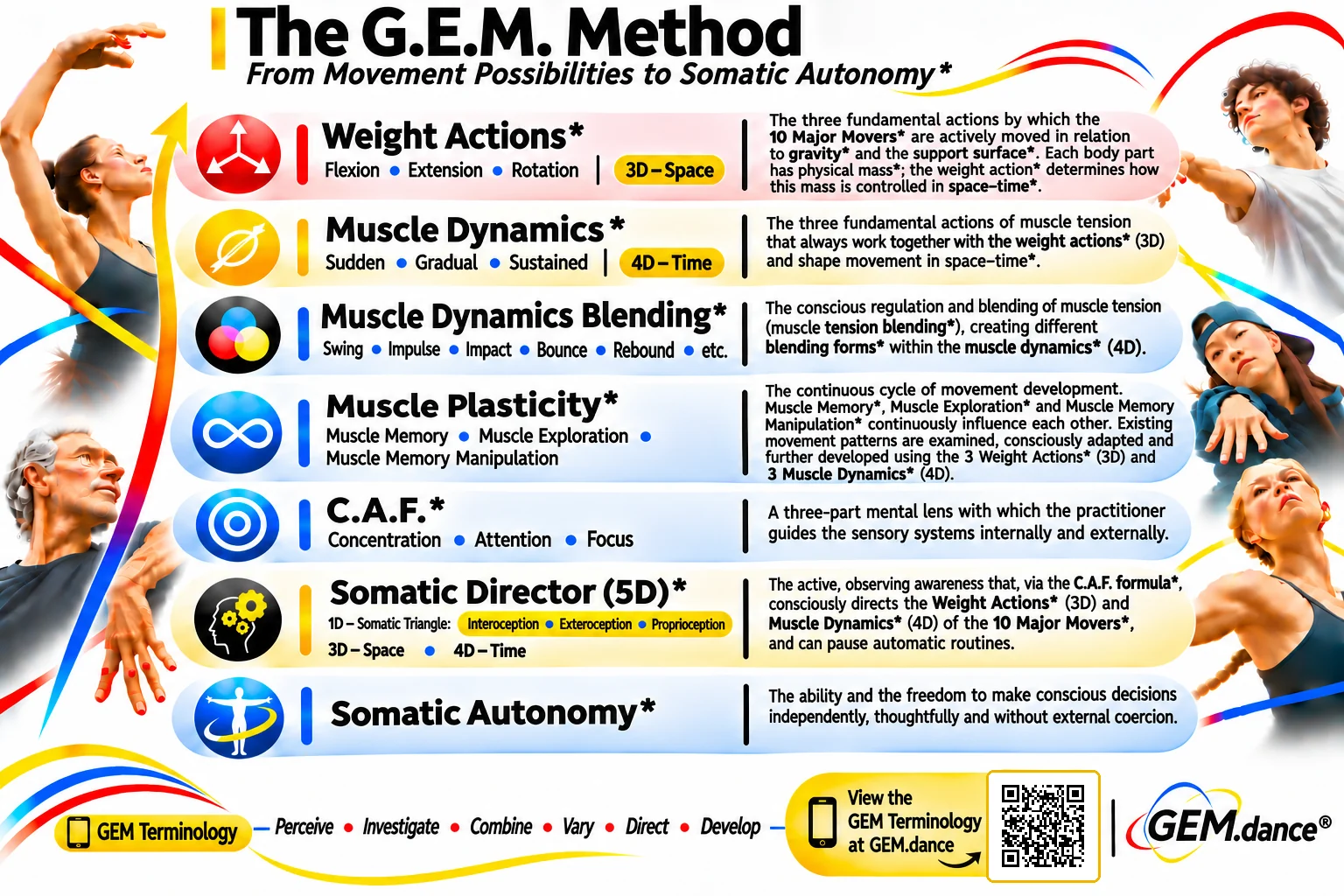
The body’s network in which the Somatic Triangle* (1D), C.A.F. Navigation* (2D), Weight Actions* (3D) and Muscle Dynamics* (4D) work together across the 10 Major Movers* under the direction of the Somatic Director* (5D) to create deliberate Blended Forms* in spacetime*.MT / The MT Switch* (GEM neologism)
MT stands for Micro-Training*. The MT Switch* is a mental cue that practitioners use during a routine to shift their Attention to conscious Body Awareness*. At that moment, they can explore the Weight Actions* (3D) of the 10 Major Movers* and vary how they perform them using the three Muscle Dynamics* (4D).Muscle Chain* (GEM neologism)
The continuous physiological chain through which all the muscles in the body work together via the elastic connective tissue (fascia*). A change in mechanical force at the base travels through the pathways in the tissues to the rest of the skeleton.Muscle Dynamics* / 4D (GEM neologism)
The general GEM term for three distinct, pure Muscle Dynamics. Each represents a single element of muscle tension (🔴 sudden, 🟡 gradual and 🔵 sustained). These three elements are distinct and form the basis for analysing muscle tension in the GEM Method. Muscle Dynamics refers to how muscle tension continually alternates and changes across different parts of the body during movement. Duration, tempo, force and adjustments in muscle tension all play a role.Muscle Dynamics Blending* / 4D (GEM neologism)
Combining and transitioning between the three distinct, single Muscle Dynamics (🔴 sudden, 🟡 gradual and 🔵 sustained) during three-dimensional Weight Actions* (bending, extending and rotating), under the direction of the Somatic Director* (5D). These combinations and transitions create composite four-dimensional Muscle Dynamics, known as Blended Forms*, such as Vibration* and Swing*. The individual Muscle Dynamics remain recognisable within the composite movement. The combinations and transitions can vary from person to person in muscle tension, duration and tempo, contributing to each person’s way of performing the movement.Muscle Exploration* (GEM neologism)
Deliberately exploring movement habits and current Muscle Memory through active Body Awareness*. During this internal exploration, the practitioner pauses the automatic routine, creating physiological* scope to introduce variation in spacetime*.Muscle Memory Manipulation* (GEM neologism)
Varying and adapting existing movement habits as they occur. This takes place when previous training and learned terminology come together with internal input and signals from the body. The nervous system* then responds to the surroundings to create a new movement form.Muscle Plasticity* — The Continuous Cycle of Movement Development
A model developed within the GEM Method in which Muscle Memory*, Muscle Exploration* and Muscle Memory Manipulation* continually influence one another.
Existing movement patterns are explored, deliberately adapted and further developed using the three Weight Actions* and three Muscle Dynamics*. New patterns can be learned and become automatic.
Within the GEM model, the Somatic Director (5D)* consciously directs the Movement Alphabet* and makes it possible to switch between Automatism* and Somatic Autonomy*. The three processes can occur simultaneously and have no fixed order.Muscle Tension* / Muscle Tone*
The current, measurable level of activity in a muscle group at a specific moment. This tension may range from active contraction to complete physiological rest without an immediate change in the joint angle.Muscle Tension Blending* (GEM neologism)
Regulating physical force within a specific muscle group or region of the 10 Major Movers*. The practitioner uses a physiological slider to shift deliberately between maximum muscle tension and complete muscle relaxation (Release*) within the Weight Actions* (3D). This is essential for recovery and for releasing unconscious patterns of fixed muscle tension.Myofascial* Activation (GEM neologism)
Applying physical pressure or compression to the elastic connective tissue around the 10 Major Movers* to calibrate the current flow of proprioceptive* information to the thalamus*. The body’s elastic connective tissue can be compared to a close-fitting stretch suit beneath the skin that surrounds all the muscles and bones.Nervous System* / The Communication Network
The body’s internal physiological wiring, through which the main control panel (the brain*), the sensors in the tissues and the muscle groups continually exchange signals and information to regulate movement in spacetime*.Neurorehabilitation*
A targeted physical recovery programme that focuses on training and restoring the communication network (the nervous system*) after neurological events, migraine or overstimulation, so practitioners can independently rebuild functional control and balance.Pathways* (GEM neologism)
The deliberate choice to shape an Air Pathway* or Floor Pathway* as linear and direct (geometric) or flowing and indirect (organic).Physical Baseline* (GEM neologism)
The body’s present state of rest, tension, energy and mobility. In the GEM Method, practitioners always start training from this current biological state, free from performance pressure and personal judgements about their own bodies.Physical Carrier* (GEM neologism)
The machinery of the body. It comprises all the bones, muscles, joints and organs that together enable a person to move and show themselves in spacetime*.The Poem / Group Autonomy* (GEM neologism)
The choreographic and bodily (somatic*) process in which a group of dancers moves in sync in spacetime* while retaining individual identity and blending Muscle Dynamics* in real time. The process focuses on the proprioceptive* experience of embodiment in theatre.Proprioception / Body Awareness* (GEM neologism)
The sensory system that registers the current positions and angles of the bones (3D) and mechanical muscle tension (4D), including the auditory feedback from Acoustic Absorption*.
Visual anchor — 🔵 Blue. This colour represents the architecture of Form*.Proprioceptive* Signals
The continuous flow of information from the body’s tissues that informs the Somatic Director* (5D) about the current position of the bones (3D) and the tension in the connected Muscle Chains* (4D).Quality
In the GEM Method, force refers to the force expressed in an action or movement. The body and brain use the energy available from the Source, and this energy is expressed in the force with which a movement or action is performed. The Form and Dynamic of the movement help determine how that force is expressed.Quality in Movement*
The degree of conscious sensory presence and active C.A.F. Navigation* (2D) during a physical action. This differs neurologically from simply repeating a given number of movements (quantity).Rebound* (GEM neologism)
A reflexive return of mechanical energy in the opposite direction after an Impact*, directed through a Weight Action*.Rewriting Physical Habits*
Using conscious proprioception* to deactivate ingrained, automatic movement patterns and replace them with active, functional choices.Sensory* / Relating to the Senses (GEM neologism)
Anything relating to sensory perception within the Somatic Triangle* (Internal Perception*, Body Awareness* and External Perception*).Sensory* Lines (GEM neologism)
The interplay of symmetrical, asymmetrical, geometric and organic lines that an external observer may detect when the muscles within a region or an entire Muscle Chain* are deliberately and harmoniously connected under the direction of the Somatic Director* (5D).Shaking*
The regulation of muscle tension through repeated bending and extending of the joints to produce a larger movement (macro-movement*) of the muscle groups surrounding the bone tissue.Somadimensions* (1D–5D)
Within the GEM Method*, the Somadimensions* form a dynamic and reciprocal system of five interconnected dimensions of investigation:
- 1D – Somatic Triangle* — Interoception, Proprioception and Exteroception.
- 2D – C.A.F. Navigation* — Concentration, Attention and Focus.
- 3D – Weight Actions* — Bending, Stretching and Rotating.
- 4D – Muscle Dynamics* — Sudden, Gradual and Sustained.
- 5D – Somatic Director* — Conscious regulation of the Somadimensions*.
Perception, navigation, movement, muscle dynamics and conscious regulation continuously influence one another. The Somatic Director* (5D) can consciously direct the other dimensions while simultaneously being influenced by information and changes within those dimensions.
The Somadimensions* do not follow a fixed sequence. Their changing combinations create opportunities to explore, modify and develop movement, and to intentionally switch between Automatism* and Somatic Autonomy*.
Somaflow* (GEM neologism)
The continuity of movement as one or more body parts move in spacetime* from a starting point (Form A) to an end point (Form B). Each position reached becomes the starting point for the next movement. The ABABAB principle represents this process. In short, Somaflow is the continuous flow of movement from A to B, with B becoming the new A each time.Somatic* / Bodily (GEM neologism)
The experience of the body and conscious direction working together as a whole, so that movement is experienced from within.Somatic Autonomy* (Bodily Independence)
The ability to sense what is happening within your own body and use that information to choose and direct your movements.The Somatic Director* / 5D Direction (GEM neologism)
The Somatic Director* refers to the role of active awareness in organising and directing movement. 5D Direction* connects perception through the Somatic Triangle* (1D), C.A.F. Navigation* (2D), knowledge and choices in the organisation of the Somadimensions*, bringing together the three-dimensional Weight Actions* (3D) and four-dimensional Muscle Dynamics* (4D) of the 10 Major Movers* in spacetime*.Somatic Lifestyle* / Body-centred Lifestyle (GEM neologism)
A way of life in which practitioners deliberately align their choices about sleep, electronic devices, food and drink with the laws of the living body. The aim is to support their own Body Awareness (proprioception*) and promote calm in the nervous system*.Somatic Triangle* (GEM term)
The interconnected network of Internal Perception* (interoception*), Body Awareness* (proprioception*) and External Perception* (exteroception*). These three forms of perception provide different kinds of information about the body and its surroundings and continually influence one another. Together, they form the sensory basis for perceiving, organising and developing movement within the GEM Method.Somatosensory Cortex* / The Site of the Internal Map
The specific area of the main control panel (the brain*) where the invisible three-dimensional map of the body is stored, allowing the brain to register the exact current positions and angles of the bones in spacetime*.Source* – Energy Management (GEM neologism)
The GEM term for the body’s current energy reserves within the first Somadimension* (1D). The model explains this available energy by comparing it to the fuel that powers the body’s engine.Sources* – Energy Management (GEM neologism)
Within the GEM Method, the Source is the inner starting point from which a person feels and acts. Feeling forms the Source. Emotion is the Form through which that feeling is expressed. The Source can be nourished both literally and figuratively. The available energy can be replenished, stored and used. A person has access to different sources and ways to nourish and draw on the Source.Spacetime* (GEM neologism)
The body’s physiological scope for movement, within which the Somatic Director* (5D) links the three-dimensional Weight Actions* (3D) of the 10 Major Movers* with four-dimensional Muscle Dynamics* (4D) to shape and adjust movement as it happens.Swing*
A swinging movement in spacetime* that starts with a sudden (🔴) muscular Impulse*, continues gradually (🟡) through momentum and slows under the effect of gravity.Thalamus* (GEM neologism)
The central filtering station in the brain* that determines which stimuli reach conscious awareness. When this filtering system processes a large amount of exteroceptive* stimuli associated with stress, neurological noise arises. Within the GEM Method, this station is developed somatically* through the C.A.F. Formula* (C.A.F. Navigation*, 2D) to regulate that noise. This activates the brain’s ability to focus in the moment on the current Weight Actions* (3D) and Muscle Dynamics* (4D) of the 10 Major Movers*.Turning*
Mechanical rotation of the joints about their own axes or the body’s axis, driven by a sudden (🔴) or gradual (🟡) muscular impulse*.Unilateral / Bilateral Use
Using the limbs on one side (unilateral* / asymmetrical) or on both sides at the same time (bilateral* / symmetrical or asymmetrical) in relation to the body’s central axis to regulate movement.Vascular Tone* / Tension in the Blood Vessels (GEM neologism)
The degree of tension in the blood vessels (their narrowing and widening), controlled by the nervous system*. In the GEM Method, it serves as an indicator of stress and relaxation.
Increased tension (high vascular tone*) occurs when the body experiences elevated baseline stress or performance pressure and is expressed in reduced tissue mobility.
Reduced tension (low vascular tone* / vasodilation) occurs when the inner dialogue begins and Focus shifts to internal feedback, leading to a lasting reduction in tension in the blood vessels.Vibration*
A rapid succession of sudden (🔴) micro-impulses and brief periods of sustained (🔵) fixation in the muscles, transmitting a fine vibration through the joints.The Way* (GEM neologism)
The structured route and the open menu of choices on the GEM platform. These allow practitioners to explore their movement possibilities independently, step by step, free from any single predetermined view of how the body should move or any prescriptive doctrine.Weight Actions* (GEM neologism)
The three basic mechanical actions of the joints (bending, extending and rotating) that actively shift the physical weight of the 10 Major Movers* in relation to gravity and the supporting surface. Each part of the body has physical mass. The Weight Action* determines how that mass is controlled in spacetime*.

The Meaning and Development of Words
Language helps people put thoughts, experiences, observations and actions into words and share them with one another.
A word can have several meanings. Terms such as energy, force and dynamics, for example, are used in different ways in physics, music, dance and everyday life.
The GEM Method therefore explores what a term means, which phenomena it describes and how it can be applied in practice.
This includes studying the origins and history of words (etymology).
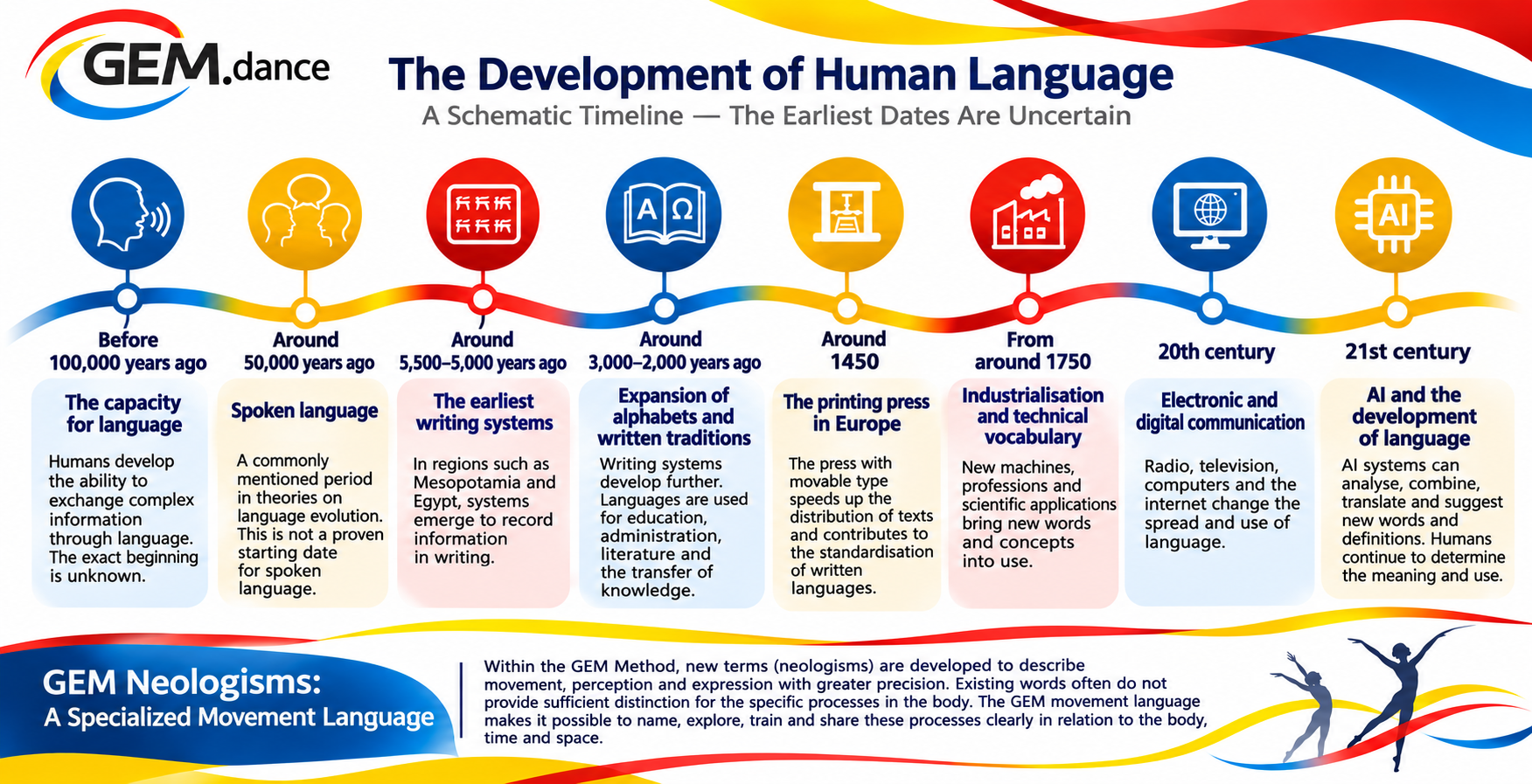
The Evolution and Development of Human Language
Human language has developed over a long period. Spoken language probably emerged long before people began to write.
When people first used complex spoken language is unknown. To investigate this question, researchers study human evolution, brain development, archaeological findings and the development of communication, among other areas.
The earliest known writing systems emerged around 5,000 to 5,500 years ago, including in Mesopotamia and Egypt.
Languages changed over the centuries. New words emerged, existing words took on different meanings and languages influenced one another.
Some languages developed into new forms. Others fell out of everyday use as fewer people passed them on to later generations.
The development of printing, industrialisation, science, electronic communication and computers created new ways to record and share knowledge. In the 21st century, artificial intelligence (AI) plays a new role in analysing, translating, comparing and developing language.
Language continues to evolve as people seek to describe new experiences, discoveries, thoughts and phenomena.
Why Does the GEM Method Develop New Words?
During research, observations may reveal phenomena that existing words describe without enough precision to distinguish between them.
The GEM Method therefore develops its own terms and gives existing words new meanings (neologisms).
Developing a term can take several years. Reflection, observation, research, comparison and practical application can help clarify and refine its meaning.
Together, these terms form part of the GEM Method’s own terminology, which includes the Movement Alphabet*.
How Do You Use the GEM Dictionary?
This dictionary explains the terms used in the GEM Method.
Terms marked with an asterisk (*) in the chapters can be looked up here in alphabetical order.
The definitions help readers understand the terms and connect them to perception, thinking and practical application.
The dictionary serves as the central reference for all chapters of the GEM Method and helps practitioners develop and organise their own inner dialogue.
A Dictionary in Development
The GEM Method is an ongoing research process. New observations, questions, practical experiences and insights may lead to the development, clarification or addition of terms.
The GEM Dictionary grows as this research continues.